In DDI’s Global Leadership Forecast 2025, 64% of leaders identified setting strategy as an essential skill, yet only 37% reported receiving training in it. That is a gap in development, not a verdict on anyone’s ability. But it helps explain why “think more strategically” can be a frustrating instruction.
The calls I get often sound something like this:
“Our CEO gave us massive KPIs to hit. We don’t have a strategy behind them. We’re just expected to make it happen.”
“Someone brought a strategic-planning template from their last company. Now we’re supposed to plug everything into it.”
“My team needs to learn how to think strategically.”
These are different problems arriving under the same label: we need a strategic plan. Before opening a template, I want to understand what the plan needs to help people decide.
These three strategic planning examples show that work: diagnosing the situation, choosing where to focus, making tradeoffs, coordinating people, and testing whether the approach holds up. First, let’s look at why you might need a plan in the first place.
SignalGrid, HarborSeal, and Arcwell are fictional teaching examples. Their figures are illustrative targets and assumptions, not client results. The separately labeled Salesforce example draws on public sources.
In this guide
- Why companies need strategic planning
- What a useful strategic plan includes
- Using the 5Cs to develop a strategic plan
- How a strategist turns analysis into a plan
- Example 1: A B2B SaaS company chooses vertical focus
- Example 2: A manufacturer chooses a market opportunity
- Example 3: Marketing turns a corporate priority into execution
- Five questions to pressure-test your plan
- Frequently asked questions
Why do companies need strategic planning?
Companies need strategic planning when an important ambition or change requires choices about customers, competitive advantage, resources, and coordinated action. The work should resolve uncertainty and competing priorities. Its scope depends on what is missing: a direction, a credible route to a target, stronger judgment, or commitments from the people who must deliver.
Here are six useful starting points. More than one may apply.
1. You have a target, but no credible route to it
A CEO can set a 30% growth target. That does not establish which customers will buy, why they will choose you, how much growth comes from retention or expansion, or what the team needs to deliver. Build the bridge from today’s performance to the target. If the evidence leaves a gap, bring leadership choices about investment, timing, risk, or the target itself.
2. You have a template, but the thinking has not happened
A template can give people a common language. The problem starts when its headings determine the conversation before anyone has diagnosed the business. A plan from a former employer carries assumptions about that company’s customers, economics, capabilities, and decision rights. Keep the useful questions. Test the assumptions again.
3. Your team needs to build strategic judgment
“Be more strategic” becomes useful when it describes observable work: interview customers, connect market changes to business implications, compare options, recommend a choice, and explain what would change your mind. Coach those moves on a live business question. Also check whether people have access to evidence, time to think, and permission to challenge an inherited priority.
4. Teams agree with the direction but have not committed to the work
Sales likes the target segment. Product likes the idea. Operations is already at capacity. Agreement in a meeting leaves the dependencies unresolved. This situation needs explicit commitments: which customers sales will pursue, which proof marketing must provide, what operations can deliver, and what leadership will fund or stop.
5. Your market has changed enough to question the old plan
A new competitor, changing buying process, emerging technology, or newly available capability may change where you can win. Revisit the assumptions affected by that change. A focused market review may be enough; a shift in your business model or target customer may require a broader strategy reset.
6. You have more opportunities than capacity
Four attractive markets can still be three too many for the same engineering team. Compare customer urgency, commercial potential, your ability to win, time to revenue, and resource demands. Then sequence the opportunities. “Later, if this evidence appears” is a useful decision when it has a clear trigger and owner.
When is strategic planning becoming a check-the-box exercise?
Ask what decision the process is allowed to change. If every initiative must survive, the budget cannot move, assumptions cannot be challenged, and no one can decline work, the exercise has little room to shape strategy. It may still serve a reporting requirement. Be clear about that purpose.
An annual planning cycle can be valuable when it tests assumptions and renews commitments. If the direction remains sound and the obstacle is a missed handoff, an unclear owner, or a delayed approval, fix that operating problem first. You do not need to reopen the entire strategy to resolve every execution issue.
My test is straightforward: after planning, can the team make a consequential decision more clearly—and do the people affected know what they have committed to?
What does a useful strategic plan include?
A useful strategic plan connects five things: a diagnosis of the situation, a choice about where and how to compete, measurable goals and objectives, coordinated actions that reinforce the choice, and a way to learn from results. If one of those pieces is missing, the plan is likely to become either a wish list or a project tracker.
At Strategy Kiln, our philosophy is to make strategy practical enough to guide the next customer conversation, investment decision, and team meeting. That means understanding what matters, choosing where to focus, and agreeing on the work together. Our OCCAM’s Strategy Razor brings those habits together: Open, Compress, Coordinate, Activate, and Measure.
Here is the practical difference among those parts.
- The diagnosis explains what is really happening. It separates the visible symptom from the underlying constraint or opportunity.
- The choice identifies where the organization will focus, how it expects to win, and what it will not pursue.
- The goal describes the desired future. Objectives make that future measurable and time-bound.
- Coordinated actions turn the choice into a system. Marketing, sales, product, operations, people, and investment should reinforce one another rather than pull in different directions.
- Measures and learning rules show whether the strategy is working and what evidence would cause the team to persist, adapt, or stop.
This is one reason I like the GOST framework. Goals, objectives, strategies, and tactics give a plan a clear spine. The value comes from making the connections explicit: which strategy supports the objective, and which tactics make that strategy work.
To work through those connections with your team, use my GOST framework guide and Amazon example. Start with one objective and trace each proposed tactic back to the strategic choice it supports.
How do you use the 5Cs to develop a strategic plan?
Use the 5Cs—Context, Customers, Competitors, Collaborators, and Company—to examine the situation before choosing a direction. Turn the evidence into implications, compare possible responses, and then decide where to focus. The analysis earns its place in the plan when it changes a decision.
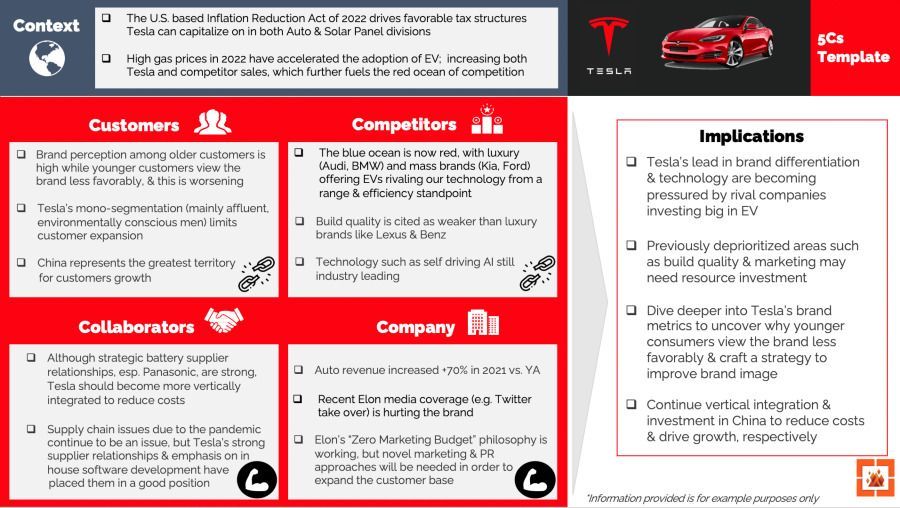
The 5Cs is probably my favorite marketing framework because it gives me a way to think through a business. I start outside the company and work inward. Use the questions and Tesla example in my 5Cs marketing guide to examine your own situation, then write down what the evidence changes about your plan.
Context: What has changed in the market or buying environment, and which assumption in our current plan does that challenge?
Customers: What are customers trying to achieve, what is stopping them, and what would make changing worthwhile? Separate their words and behavior from our internal explanation.
Competitors: What alternatives does the customer have—including doing nothing—and where can we offer a meaningful advantage?
Collaborators: Whose access, expertise, technology, delivery capacity, or influence is necessary to win? Consider external partners and the internal teams whose commitments the plan needs.
Company: Given that evidence, what can we credibly deliver, what must we build or obtain, and what should we decline?
The important work happens between the Cs. Suppose customers hesitate because implementation looks risky, a competitor wins with hands-on onboarding, and a partner already has the integration capability you lack. The implication may be that reducing adoption risk matters more than adding awareness. A sensible next move is to test a supported pilot with that partner before increasing campaign spend.
For each important finding, write four things: what we observed; what it means for a customer or our business; which choice it supports; and what evidence or action comes next. Keep facts, interpretations, and assumptions distinguishable. Five full boxes can still leave the strategic question unanswered.
Use the 5Cs to build the diagnosis, segmentation and positioning to sharpen the choice, and GOST to connect goals, objectives, strategies, and tactics. The 4Ps—product, price, place, and promotion—then help check whether the offer and route to market support that choice.
How does a strategist turn analysis into a plan?
Strategic thinking is not a lightning bolt. It is a disciplined sequence of questions.
First, separate symptoms from constraints. “Pipeline is down” is a symptom. The constraint might be weak positioning, poor retention, a narrow market, slow sales follow-up, missing product capability, or an offer that creates interest without urgency. Each diagnosis points to a different plan.
Second, identify the decisions that would materially change the odds. A plan should not preserve every option. It should concentrate resources on the few choices that matter most.
Third, compare alternatives. I look at market attractiveness, customer urgency, right to win, economics, timing, capability, and risk. A large market is not automatically an attractive opportunity. A clever idea is not automatically an advantage. A popular tactic is not automatically a strategy.
Fourth, make the tradeoff visible. If the organization says yes to a segment, capability, market, or operating model, what will receive less money, time, and attention? Strategy and tactics are connected, but they are not interchangeable. “Launch a campaign” is a move. “Concentrate on one customer group where our implementation expertise creates an advantage” is a choice that can organize many moves.
Finally, translate the choice into objectives, actions, owners, and a review cadence. A strategy that never changes the calendar, budget, product backlog, sales conversation, or meeting agenda is probably still a presentation.
The three examples below use that same sequence.
Strategic planning example 1: A B2B SaaS company chooses vertical focus
SignalGrid is a hypothetical workflow SaaS company with $8 million in annual recurring revenue. It sells to mid-market customers across healthcare, professional services, logistics, and financial services.
Growth has slowed. Marketing still produces leads, but sales says too many are weak. Sales still closes deals, but customer success sees uneven adoption. Product receives a different request from every industry. Leadership’s first instinct is familiar: increase campaign volume, add more content, and ask sales to push harder.
That response treats the symptom—slower growth—as if the company simply needs more activity.
Diagnose the real constraint
The team studies win-loss notes, retention, expansion, product adoption, and sales-cycle data by segment. A pattern emerges. Healthcare operations customers are not the largest segment today, but they retain longer, expand more often, and use a repeatable group of high-value workflows. SignalGrid also has several credible healthcare references and implementation knowledge that generalist competitors struggle to match.
The constraint is not a lack of awareness. It is diffuse positioning. SignalGrid is asking a small sales and marketing team to explain a broad product to too many types of buyers. Product and onboarding are absorbing the same cost.
Compare real alternatives
Leadership considers three options.
- Increase paid acquisition across all current industries.
- Build a self-service tier to reach smaller customers.
- Focus new-logo growth on healthcare operations teams and align the company around that segment.
The first option is fast, but it amplifies the current conversion problem. The second could open a new market, but it requires product, pricing, support, and onboarding changes. The third narrows the market in the near term, but it lets the company put positioning, proof, product, sales, and customer success behind one repeatable advantage.
The team chooses healthcare operations.
State the strategy and the tradeoffs
SignalGrid will focus new-logo growth on healthcare operations teams at organizations with 500–5,000 employees. It will win by combining flexible workflow software with implementation expertise, fast time to value, and evidence for a small set of high-stakes operational use cases.
That choice comes with explicit noes.
- Pause broad “workflow software for everyone” campaigns.
- Do not build the SMB self-service tier this year.
- Do not add a second vertical until healthcare clears agreed conversion, activation, and retention thresholds.
None of the rejected ideas is ridiculous. That is precisely why the tradeoff matters. Strategy is rarely a choice between a brilliant idea and an obviously stupid one. It is usually a choice among several reasonable opportunities that cannot all receive full force.
Build the goal, objectives, and measures
The goal is qualitative: become the most trusted workflow platform for complex healthcare operations teams in the selected mid-market segment.
The objectives make that ambition testable over 12 months:
- Grow ARR from $8.0 million to $11.2 million.
- Create $15 million in qualified healthcare pipeline, measured as potential annual recurring revenue, and convert 24% into new ARR within the planning year.
- Lift gross revenue retention for healthcare customers from 91% to 95%.
- Increase expansion revenue from healthcare accounts by 20%.
Check the arithmetic before treating those objectives as a plan. In this fictional scenario, $8.0 million of starting ARR minus $0.8 million of company-wide churn and contraction, plus $0.4 million of expansion and $3.6 million of new ARR, produces $11.2 million. The new ARR requires $15 million of qualified pipeline at a 24% value-based conversion rate, with contracts starting in the year. Those are assumptions to validate with finance and sales, not proof that the target is achievable.
Revenue is a lagging measure. The team also chooses leading indicators: target-account engagement, discovery-to-opportunity rate, sales-cycle length, pilot activation, time to first value, referenceable customers, and product usage linked to expansion.
Coordinate the actions
The strategy changes how several functions work.
- Marketing interviews wins, losses, and expansion accounts; builds a healthcare problem narrative; and concentrates content, paid media, events, and search around two priority use cases.
- Sales builds a 150-account target list, maps the buying committee, and uses discovery questions designed around operational risk and implementation complexity.
- Product packages the most valuable workflows and prioritizes integrations that matter to the segment.
- Customer success creates an implementation blueprint, adoption milestones, and a reference program.
- Leadership reviews segment economics and conversion every month instead of reviewing channels in isolation.
Define the learning rule
The strategy gets enough time to produce evidence, but it does not become a religion.
SignalGrid continues if the segment produces better opportunity conversion and faster activation. It adjusts the implementation or offer if the right accounts engage but pilots stall. It reopens the segment choice if healthcare retention fails to outperform other segments after a representative cohort matures.
That final step matters. Focus is not the same as stubbornness. Good strategy commits resources and names the evidence that would justify a change.
How this translates into the real world: Salesforce Health Cloud
Salesforce offers a recognizable example of shaping a broad software platform around a specific industry. In September 2015, it announced Health Cloud, built on Service Cloud, with capabilities for patient profiles, care coordination, and communication across care networks.
Salesforce developed the offering with healthcare organizations including UCSF and Philips. Its announcement also named integration and implementation partners such as MuleSoft and Accenture. The proposition connected a defined customer problem with industry workflows and the partners needed to deliver them.
My interpretation: choosing an industry becomes more convincing when product, proof, and delivery change together. For SignalGrid, that means investigating which workflows and implementation capabilities make its healthcare focus credible, then aligning sales and marketing around them.
The comparison has limits. Salesforce’s announcement does not establish that it abandoned other industries, followed SignalGrid’s planning process, or achieved SignalGrid’s fictional targets. It illustrates industry-specific product and ecosystem choices; it is not evidence of a whole-company narrowing strategy or a disclosed internal strategic plan.
Strategic planning example 2: A manufacturer chooses a market opportunity
HarborSeal Manufacturing is a hypothetical component manufacturer with experienced engineers, a strong quality reputation, and one underused production line.
The opportunity list looks exciting: electric vehicles, medical devices, data-center cooling, and consumer private-label products. The initial proposal is to ask sales to “go explore” all four. It sounds flexible. In practice, it spreads the company’s scarcest resource—engineering and qualification capacity—across four learning curves.
Start with the constraint, not the market size
Machine time is available. Engineering time is not. Every serious opportunity requires drawings, material selection, prototypes, tests, commercial estimates, quality documentation, and customer review. Chasing four markets does not create four options for free. It creates four partially funded commitments.
The team evaluates each market against six criteria:
- Market growth and customer urgency.
- Fit with current materials, equipment, and quality systems.
- Time to a paid pilot.
- Gross-margin potential.
- Switching barriers and repeat revenue.
- Capital, certification, and customer-concentration risk.
The largest market does not automatically win. Electric-vehicle programs offer scale, but qualification is long, price pressure is high, and a single program could dominate the opportunity portfolio. Consumer work moves faster but offers weak margins and little differentiation. Medical devices fit the quality culture, but the selected applications require certifications and sales relationships the company does not yet possess.
Data-center liquid-cooling components are not the easiest opportunity. They are the best intersection of attractive demand and credible right to win. Equipment makers value rapid design iteration, traceability, small-to-medium production runs, and dependable collaboration—capabilities HarborSeal already has.

Make the market-entry choice
HarborSeal chooses to enter data-center liquid-cooling components through engineered pilot programs with equipment makers and integrators. It will compete on design collaboration, speed, traceability, and dependable production—not lowest unit price.
The tradeoffs are concrete.
- Do not build a speculative high-volume line before design wins.
- Do not accept consumer private-label work that absorbs engineering capacity below the margin floor.
- Keep EV conversations exploratory until a partner funds qualification or the opportunity clears the same hurdle rate.
Set stage-gated objectives
The goal is to establish a profitable growth platform in high-performance cooling components.
The 12-month objectives are:
- Secure six paid prototype programs and two production design wins.
- Build $4 million in qualified pipeline with an expected gross margin of at least 25%.
- Cut prototype-to-quote time from 21 days to 10 days.
- Keep any single new-market customer below 35% of opportunity value.
The company deliberately measures the steps before revenue: qualified technical conversations, paid prototype conversion, validation success, time between stages, quoted margin, forecast concentration, and production-readiness risk.
Translate the strategy into a market-entry system
HarborSeal conducts ten structured customer interviews with design engineers and sourcing leaders. It creates a rapid-prototype cell and a standard application-engineering process. It assembles a proof kit with material data, quality documentation, sample geometries, and test results. Commercial outreach targets a short list of equipment makers and integrators rather than buying a giant contact list and calling it market development.
Before the leadership review, the commercial lead asks engineering to reserve two days per week for the first eight weeks of discovery and design work; finance to test margin assumptions; and operations to confirm pilot capacity. These are illustrative requests. Each owner must confirm feasibility and identify what existing work would move.
The sales lead owns the first ten customer interviews and records buying triggers, approval steps, and willingness to fund a prototype. An integration partner helps identify technical access requirements. The team turns those findings into a customer promise it can support: faster, documented design validation with a clear path into production.
The 4Ps make that promise concrete: a defined prototype package; pricing that covers agreed engineering work; access through equipment makers and integrators; and technical proof that answers the buyer’s adoption concerns. The leadership ask is staged engineering capacity and a capped pilot budget, followed by a separate tooling decision when evidence justifies it.
Every opportunity moves through a stage gate: discovery, paid prototype, validation, commercial quote, and production approval. Leaders can now see whether the strategy is learning or merely consuming engineering hours.
Dedicated tooling is approved only after two design wins or contracted volume. If prototype interest is high but willingness to pay, qualification success, or production economics miss the thresholds, the team revisits the entry thesis.
This is what market-opportunity strategy looks like in practice. It is not picking the market with the most impressive forecast. It is choosing the opportunity where demand, advantage, economics, and risk fit together—and sequencing investment so the company earns the right to scale.
If your team is weighing several attractive markets, Strategy Kiln can help you examine the customer evidence, compare the tradeoffs, and decide where to commit your resources.
Strategic planning example 3: Marketing turns a corporate priority into execution
Arcwell Industrial Services is a hypothetical multi-region B2B company. Leadership’s priority is straightforward: grow enterprise accounts.
Marketing is already busy. It runs webinars, trade shows, paid search, daily social content, product launches, newsletters, sponsorships, and a steady stream of urgent sales requests. Every team can connect its work to “enterprise growth” if the phrase is broad enough.
That is the problem.
The corporate priority has not changed the audience, message, budget, ownership, calendar, or definition of success. It is directionally clear and operationally invisible.
Diagnose the translation gap
Sales and marketing use different target-account lists. Product experts describe the company’s value in technical language; sales leads with responsiveness; the website emphasizes breadth. Campaign reports reward form fills and event attendance, while leadership asks about enterprise pipeline.
The gap is not effort. It is translation. The priority needs to become a set of choices that changes what marketing does and how sales participates.
Choose an operating focus
For the next two quarters, Arcwell will concentrate on 75 named enterprise accounts in two verticals. It will use one differentiated commercial narrative, role-specific proof, and coordinated sales-and-marketing plays to move buying committees from recognition to qualified opportunity.
The team gives up work to create capacity.
- Cut the low-attendance webinar series from monthly to quarterly.
- Pause the broad brand refresh.
- Reduce always-on social production and repurpose account-relevant expertise instead.
- Decline campaigns that cannot connect to the named-account strategy or a real customer deadline.
If that list makes people uncomfortable, it is doing useful work. “Enterprise is a priority” becomes believable only when lower-priority activity loses resources.
Build the priority cascade
The goal is to make marketing a measurable enterprise-growth system rather than a collection of channels.
The six-month objectives are:
- Engage 50 of 75 named accounts with at least three relevant contacts.
- Create $6 million in qualified enterprise pipeline.
- Progress 12 accounts to stage-two opportunities.
- Raise sales acceptance of marketing-sourced enterprise leads from 45% to 75%.
The cascade looks like this:
- Corporate priority: Grow enterprise revenue.
- Marketing strategy: Concentrate resources on two verticals and 75 accounts using one differentiated problem narrative.
- Programs: Executive insight, technical proof, account-based paid media, sales enablement, customer evidence, and retargeting.
- Tactics: Role-specific landing pages, point-of-view content, account ads, executive emails, event meetings, and coordinated follow-up.
- Ownership: One account pod with a marketer, seller, subject-matter expert, and operations partner.
- Cadence: Weekly account review, monthly resource decision, and quarterly strategy review.
Agree on the customer’s next step and each collaborator’s commitment
Arcwell begins with joint sales and marketing discovery. In this fictional example, an operations buyer is worried about downtime during a supplier change. A procurement buyer needs a defensible comparison and an agreed approval process. Those concerns lead to a transition plan, operational proof, and a commercial case tailored to each role.
Sales validates the named-account list, identifies a buying trigger, and owns the next customer conversation. Marketing prepares the evidence needed for that conversation. A technical specialist checks the proposed solution. Operations confirms that the service promise is deliverable. Finance tests the economics. A channel partner joins where it can provide access or implementation support.
For each priority account, the team records the next customer decision, the evidence needed, one accountable owner, supporting collaborators, a due date, and the resource or approval dependency. “Follow up” becomes “the account lead and operations specialist will review the transition requirements with the buyer before the next sourcing decision.”
They also separate near-term opportunities with a live trigger from attractive accounts that require longer relationship-building. An upcoming contract review can justify immediate coordination. An account with no identified need or timing gets a different level of investment.
Before the executive review, each collaborator confirms the commitment or raises a specific constraint. Leadership then decides what to fund, defer, or change. The weekly meeting deals with customer movement and blocked decisions; the monthly meeting resolves resource conflicts. A quarterly review tests whether the underlying market and customer assumptions still hold.

Measure movement, not motion
The leading indicators are account coverage, buying-group engagement, content consumption, repeat visits, sales follow-up speed, and meeting quality. The lagging indicators are accepted opportunities, stage progression, pipeline, win rate, revenue, and sales-cycle length.
Arcwell expands the program only when engagement turns into accepted opportunities. If the right people engage but do not progress, the team changes the message, proof, or follow-up. If repeated evidence shows weak need or timing, it changes the account list.
Notice what happened. “Grow enterprise accounts” moved from a phrase on an executive slide to a shared audience, a choice about focus, an integrated set of programs, explicit owners, and a weekly decision-making rhythm.
If the priority sounds clear in the boardroom but dissolves into unrelated work on Monday, bring one example to a conversation with Strategy Kiln. We can talk through the decision, the people it depends on, and a useful next step.
Talk Through Your Execution Challenge
What do the three strategic planning examples have in common?
The companies are different, but the pattern is the same.
They begin with a diagnosis, not a list of aspirations. They compare alternatives instead of treating the first idea as inevitable. They make a choice that reallocates resources. They state what will not happen. They connect goals and objectives to a reinforcing system of action. And they create a way to learn before uncertainty becomes an excuse for endless debate.
This is also why a one-page strategic plan can be powerful. The page earns its place when it captures the reasoning, the choices, and the commitments clearly enough for people to use.
A polished plan should let someone trace a straight line:
Problem → diagnosis → choice → tradeoff → objective → coordinated action → measure → decision.
If the line breaks, that is where the next strategic conversation belongs.
Five questions to pressure-test your strategic plan
- What did we diagnose? Describe the constraint or opportunity in a way that explains why the current pattern persists.
- What did we choose? Name the customer, market, capability, position, or operating model that will receive disproportionate focus.
- What did we decline? Identify the reasonable activities and opportunities that will receive less or nothing.
- What changed on Monday? Show how the choice changes budgets, calendars, ownership, product decisions, sales behavior, and review meetings.
- What evidence changes our mind? Define the leading and lagging signals that cause the team to persist, adapt, or stop.
Try these questions in your next leadership meeting. Choose one priority and ask each person to explain the decision, the tradeoff, and their commitment. Differences in the answers show you where the plan still needs work.
Frequently asked questions about strategic planning examples
Still staring at a plan where everything is a priority?
Bring the target, the competing priorities, or the plan your team is struggling to use. We can talk through what needs to become clearer and where to start.
Strategy Kiln helps B2B SaaS, manufacturing, and growth-focused teams make strategy practical: clearer choices, shared commitments, and measurable action that fits the people and resources available.
Book a Free Strategy Conversation
About Adam Fischer

Adam Fischer is the founder and principal strategist at Strategy Kiln. He helps B2B SaaS, manufacturing, healthcare, professional-services, and growth-stage teams turn complex growth questions into clear priorities, aligned plans, and executable marketing systems. His B.S. in Philosophy from Northeastern University informs the questions he asks; his MBA in Marketing from the Thunderbird School of Global Management at Arizona State University helps him translate those questions into practical growth decisions.