LinkedIn Ads for SaaS can work well when you have a defined B2B buying committee, enough value per customer to support acquisition costs, and a way to track leads through to revenue. The practical question is whether you can reach the right people with a useful offer and turn that attention into qualified pipeline.
At Strategy Kiln, we use the Rising TIDE Funnel to connect Trust, Intent, Demand, and Engagement. This guide shows how to assess channel fit, plan a test, and build campaigns around what your buyers need at each stage.
When Do LinkedIn Ads Make Sense for SaaS?
Start with fit before choosing an ad format. LinkedIn is worth testing when professional attributes such as role, seniority, company size, and industry help you identify the people who influence a purchase. A specific audience is useful only if reaching it can lead to business you can serve profitably.
- Your buying committee is identifiable. You know the users, champions, and budget owners you need to reach, and can describe their problems clearly.
- Your customer economics support paid acquisition. Deal value, gross margin, retention, and sales conversion rates leave room for advertising and sales costs.
- You have something useful to offer. A relevant guide, case study, assessment, or product demonstration gives buyers a reason to engage.
- You can follow the lead through the sales cycle. Your team can distinguish a download from a qualified meeting, opportunity, and customer.
Consider other priorities first if your positioning is still unclear, your buyers are difficult to identify on LinkedIn, or a low-price product leaves little room for acquisition costs. If the business needs immediate revenue, a long-cycle awareness test may not fit the timeline. Validate the offer and economics before spreading a small budget across many campaigns.
How Much Should a SaaS Company Budget for LinkedIn Ads?
Start with the revenue you want to generate, then work backward through your sales funnel. Your required budget depends on the value of each sale, what you pay for a click, and how effectively prospects move from first interest to a closed deal.
Check out our LinkedIn Pipeline & Budget Calculator for a simple way to estimate your advertising costs and the pipeline needed to reach your revenue goal. It connects the budget to the business outcome, so you can see what needs to happen at each stage.
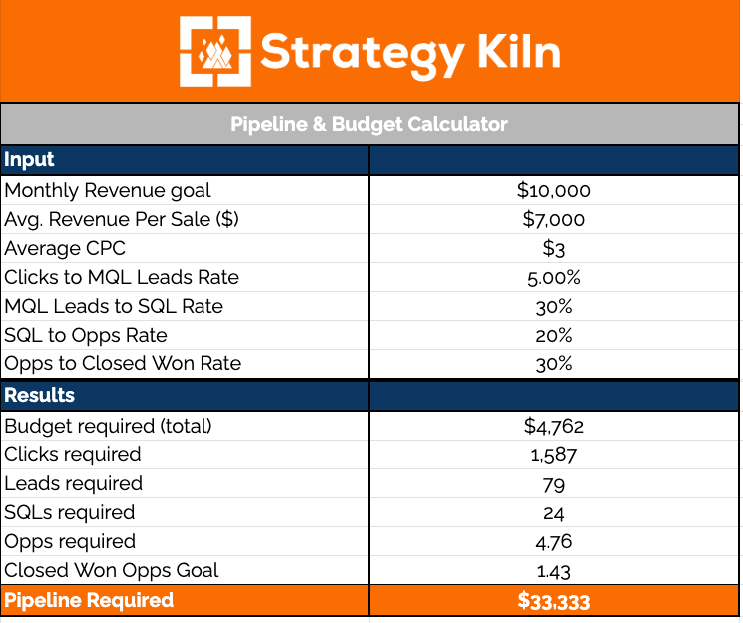
An illustrative scenario in the calculator. Replace the sample values with your own assumptions; these figures are not LinkedIn performance benchmarks or guaranteed results.
How to use the LinkedIn budget calculator
Open the Google Sheet and make your own copy using File → Make a copy, so you can test assumptions without changing the original. Enter your values in the Input section:
- Monthly revenue goal: The new revenue you want this advertising program to support. Use the same revenue basis for the goal and each sale; do not mix monthly recurring revenue with annual contract value.
- Average revenue per sale: The revenue represented by one closed deal on that same basis.
- Average CPC: Your expected cost per click. Use your own account data where available and test a higher-cost scenario if you are unsure.
- Clicks to MQL leads rate: The percentage of ad clicks you expect to become marketing-qualified leads.
- MQL leads to SQL rate: The percentage of marketing-qualified leads that become sales-qualified leads.
- SQL to opportunities rate: The percentage of sales-qualified leads that become qualified sales opportunities.
- Opportunities to closed-won rate: The percentage of opportunities you expect to turn into customers.
Agree with sales on what MQL, SQL, and opportunity mean before entering the rates. Use a consistent reporting period and allow enough time for leads to progress through the funnel. A download is not automatically an MQL, and an MQL is not automatically a sales opportunity.
What the results tell you
The calculator divides your revenue goal by average revenue per sale to estimate the closed deals needed. It then works backward through your conversion rates to calculate required opportunities, SQLs, MQLs, and clicks. Finally, it multiplies required clicks by CPC to estimate media spend. Required pipeline is your revenue goal divided by your opportunity-to-win rate.
An example using the sample inputs
With a $10,000 monthly revenue goal, $7,000 average revenue per sale, a $3 CPC, and conversion rates of 5% from click to MQL, 30% from MQL to SQL, 20% from SQL to opportunity, and 30% from opportunity to customer, the model calculates approximately:
- $4,762 in advertising spend
- 1,587 clicks and 79 MQLs
- 24 SQLs and 4.76 opportunities
- 1.43 closed deals and $33,333 in required pipeline
These are rounded model outputs, not a literal deal count or a delivery guarantee. In practice, you cannot close 1.43 deals: at $7,000 per sale, you need two whole deals to exceed a $10,000 goal. The model uses fractional expected values to show the underlying economics.
Use it to find the lever that matters most
Change one assumption at a time. If CPC rises from $3 to $6 and conversion rates stay the same, required media spend doubles to about $9,524. If the MQL-to-SQL rate improves from 30% to 40%, with the other sample inputs unchanged, required media spend falls to about $3,571. That gives marketing and sales a concrete way to discuss whether to focus on traffic costs, lead quality, or downstream conversion.
Although the result is labeled “Budget required (total),” the formula calculates advertising media spend only. Add creative, campaign management, tracking, and sales costs separately. The sheet does not calculate profit, retention, payback period, or sales-cycle timing. A monthly goal does not mean clicks purchased this month will close this month.
Use the calculator to build a starting plan, then replace assumptions with observed results. Review delivery and lead relevance early, follow opportunities through your actual sales cycle, and set a spend cap and decision criteria before scaling.
Open the LinkedIn Pipeline & Budget Calculator →
Build a Measurable LinkedIn Ads System
Campaigns work better when messaging, measurement, and follow-up connect. An individual promotion can succeed, especially with an urgent offer or an audience already in-market. For longer SaaS buying cycles, a coordinated program gives you more opportunities to earn attention and learn what moves buyers forward.
Tracking measures
Tracking is essential to help you measure the direct impact of your ads. By implementing tools like the LinkedIn Insight Tag or one of HubSpot or Salesforce’s custom tracking mechanisms, you can calculate return on ad spend (ROAS), optimize for better-performing creative, and track actions users take after viewing or clicking an ad.
Messaging layers
Clear, layered messaging ensures your audience hears the right message at the right time as they move through their buying journey. At the top of the funnel, your ads should open with broad educational themes and pain points that resonate with your buying committee. As prospects engage and move closer to conversion, messaging should evolve to highlight specific value propositions, social proof, and success stories that reinforce why your solution matters to them.
This tiered approach keeps your target audience engaged and steadily nurtures trust, which is critical for high-quality SaaS conversion on LinkedIn.
Funnel sequencing
Funnel sequencing is about ordering your LinkedIn Ads campaigns so they match how real buyers think and act, not just sending every ad to everyone in your target audience. By properly sequencing your ads, you can guide prospects forward naturally rather than overwhelming them with sales pitches that fall flat.
Proper sequencing, as shown in our Rising TIDE Funnel, starts with awareness, moves on to consideration, and only later prompts direct action. This helps you avoid asking for a demo or trial too early, which improves engagement rates and lowers wasted spend. This strategic layering ensures your ads build familiarity and credibility before pushing for conversions.
Feedback loops
Feedback loops are the mechanisms that turn performance data into strategy improvements. Instead of setting a campaign live and hoping for the best, you should regularly analyze metrics to understand where prospects are dropping off or converting. These insights allow you to refine audiences, adjust creatives, tweak messaging, and iterate on offers based on real behavior instead of guesswork.
In a SaaS context – where sales cycles are longer and decisions are deliberate – feedback loops ensure your LinkedIn Ads system learns from what is actually happening in the market and uses that knowledge to improve.
Stop Chasing Lead Volume and Start Weighting by Intent
A high number of clicks, form fills, or impressions isn’t as valuable as a smaller number of high-intent leads. This might sound obvious, but let’s take a close look at a hypothetical situation that illustrates why this is true.
Say you run two ad campaigns, with the following results:
| Campaign | Impressions | Clicks | Form Fills | Meetings Booked |
|---|---|---|---|---|
| ONE | 10,000 | 1,000 | 200 | 10 |
| TWO | 500 | 150 | 75 | 30 |
Campaign One looks better on paper: more reach, more clicks, more leads. But in reality, it only produced 10 real sales conversations. Campaign Two produced three times as many with a fraction of the volume.
That’s the difference between activity and intent.
Yes, this is a marketing basic, but we audit LinkedIn accounts and find this discrepancy all the time. You’ll often find that campaigns and creative with a higher cost per action, like a form fill, actually have a lower cost per qualified meeting booked. Building and connecting the piping to see this, and act on it, is crucial.
High-intent campaigns tend to do fewer things better:
- They speak to a specific problem, not a broad audience.
- They make the offer more selective, not more accessible.
- They align the message with where the buyer actually is in their decision process.
Low-intent campaigns usually optimize for ease (think: short forms, generic messaging, and broad positioning). High-intent campaigns optimize for relevance: sharper targeting, clearer value propositions, and content that filters out casual interest.
Your next question is probably: “How do I design a high-intent LinkedIn Ads campaign?”
The answer starts with understanding your buying committee.
Understand Your Buying Committee (Demographics and Psychology)
SaaS teams rarely have one buyer making the decision about whether or not to move forward with a vendor’s product or services. This is why I refer to your target audience as a “buying committee.”
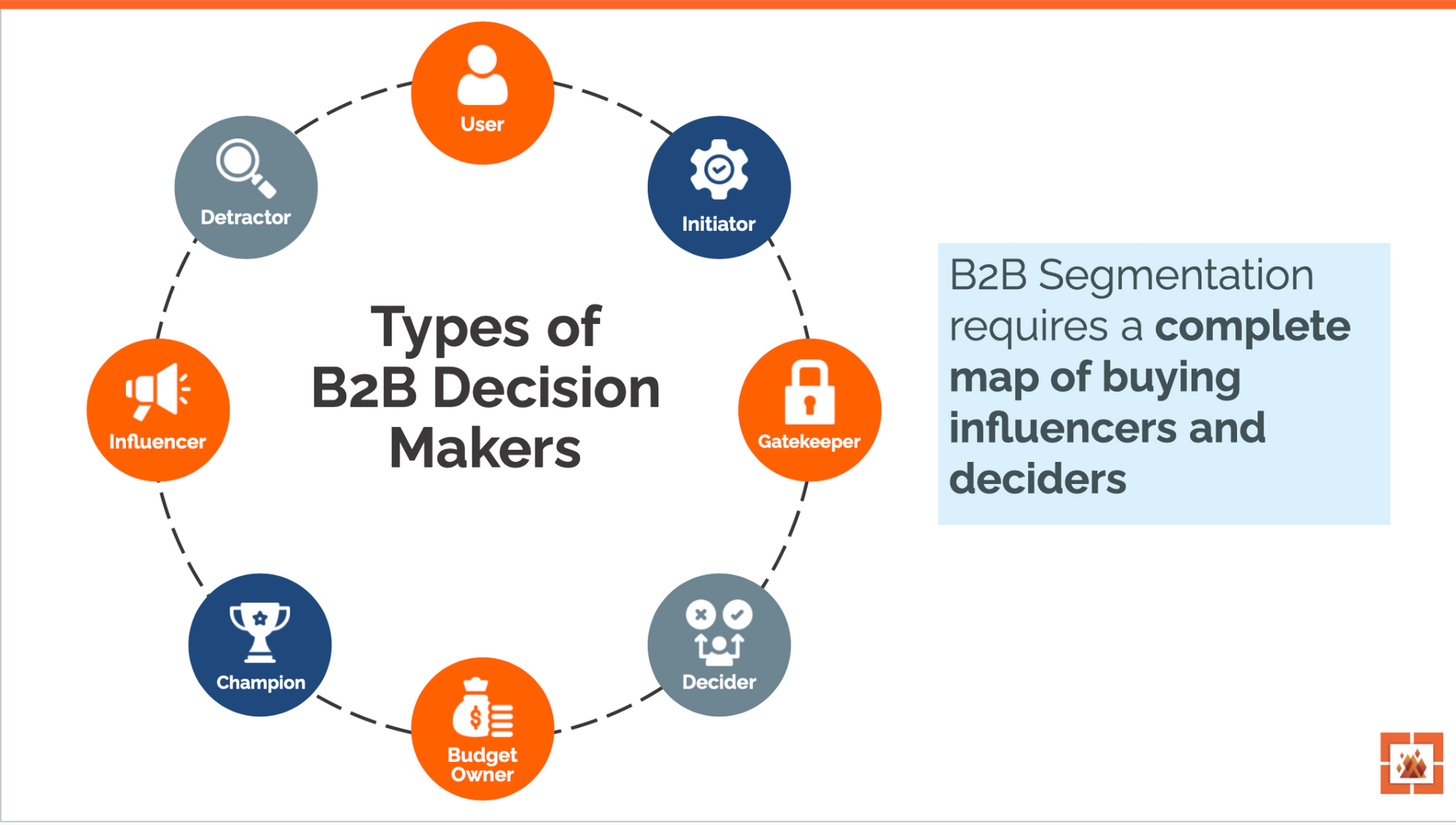
Map the user, initiator, gatekeeper, decider, budget owner, champion, influencer, and detractor when planning how to reach the buying committee.
There are a variety of roles on a buying committee at a SaaS company that impact whether or not a purchase is made. These include day-to-day users, budget owners, department heads, and finance professionals, among others.
For each role within the buying committee you need to know:
- Their pain points
- Their goals
- Their emotional drivers
A key question to ask yourself about your buying committee is, “How can I make their day-to-day lives better, and how can I communicate that in a way that will hit home?”
Your Value Proposition Is the Real Ad
It’s easy to think that performance on LinkedIn comes down to targeting settings, ad formats, or clever copy, and while that is to some extent true, none of it matters if your value proposition isn’t clear.
Before worrying about ad creative, you need to be able to answer a few basic questions:
- What problems do you solve for your buying committee?
- Of those problems, which are the urgent, “bleeding neck” issues?
- What makes your product or service different from the alternatives?
- Can you clearly demonstrate this in your ad in a way that matters?
- Why should a buyer care?
- If the ad is for a down funnel action like booking a call or demo, what will they get from the conversation?
- People don’t want to waste their time. If you’re asking for a call, be crystal clear about what they’ll gain from it. Offering an “intro call” isn’t compelling, for example. Spell out the outcome, whether that’s a tailored audit, a strategic roadmap, or a performance breakdown. When buyers understand the concrete value of the conversation, they’re far more likely to commit. Make the meeting feel worthwhile before it even happens.
If the answers to these questions aren’t obvious to you, no amount of budget or optimization will fix it.
The strongest LinkedIn Ads for SaaS are built around proof, not promises. Data, case studies, testimonials, and real customer outcomes give your messaging credibility and make your positioning tangible. It also gives you great fodder for LinkedIn’s various ad types, such as Document Ads and InMail.
LinkedIn doesn’t create your value proposition, it simply amplifies it. If your positioning is strong, LinkedIn will make it louder. If it’s weak, LinkedIn will expose it faster.
Creative Best Practices for High-Performing LinkedIn Ads for SaaS
Once your value proposition is clear and your funnel is mapped, creative becomes the execution layer that brings everything to life.
The best SaaS ads on LinkedIn feel more like helpful insights than traditional advertising. They meet buyers where they are in the funnel, speak directly to a real problem, and make it immediately obvious why the message is relevant.
Strong creative starts with understanding what your buying committee cares about at each stage of the journey. Early on, that might mean surfacing a problem they haven’t fully articulated yet. Later, it might mean showing proof that your solution actually works.
The format changes, but the goal stays the same: reduce uncertainty and build confidence.
Here are a few creative principles that consistently show up in high-performing LinkedIn Ads for SaaS:
- Clear and simple: If someone has to read your ad twice to understand it, simplify it before testing. The best ads communicate one idea, one benefit, and one next step.
- Avoid jargon: SaaS buyers don’t need buzzwords. They need clarity. Simple language builds more trust than trying to sound impressive.
- Benefit-led: Lead with what the buyer gets, not what your product does. Features explain functionality. Benefits explain value.
- Speak to pain and emotion: Even in SaaS, decisions are emotional. Ads that reflect real frustrations, risks, and aspirations drive stronger engagement.
- Make the offer obvious: Whether it’s a guide, webinar, case study, or demo, the next step should be instantly clear. Ambiguity kills conversions.
- Use negative space: For visual formats, less is more. Clean layouts, strong contrast, and focused messaging make an ad easier to understand; test their impact with your audience.
In short, great LinkedIn creative isn’t about being clever, it’s about being understood. The easier you make it for buyers to recognize themselves in your ads, the better your campaigns will perform.
The Rising TIDE Funnel: A Trust-Led SaaS Growth Model
The buying process in SaaS is slower, more deliberate, and far more trust-driven. That’s why we use the Rising TIDE Funnel, a practical model for how SaaS buyers actually move from discovery to decision on LinkedIn.
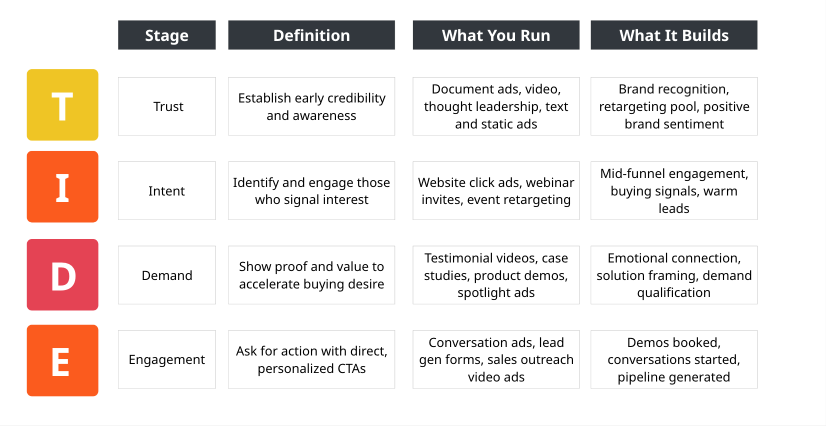
The Rising TIDE Funnel connects Trust, Intent, Demand, and Engagement with the purpose of each campaign: build credibility, identify interest, demonstrate value, and invite action.
Instead of forcing prospects straight into a demo, the Rising TIDE Funnel is built around a simple idea: earn the buying committee’s attention and trust before you ask for action.
In SaaS, especially in competitive or high-ACV markets, buyers don’t convert because they saw one ad. They convert because your brand becomes familiar, credible, and useful over time.
The Rising TIDE Funnel structures LinkedIn Ads to mirror that reality, building visibility first, nurturing understanding second, and only moving into conversion once those two things have been solidified.
When done right, this approach doesn’t just generate leads. It turns LinkedIn into a trust engine that lifts performance across every channel: organic, outbound, search, and sales.
Build a Full-Funnel LinkedIn Strategy for SaaS
Most SaaS teams run disconnected LinkedIn campaigns: a webinar here, a demo ad there, maybe a case study ad when pipeline slows down. The problem with this approach isn’t lack of effort, it’s lack of sequencing.
A high-performing LinkedIn Ads strategy for SaaS needs to be full-funnel and intentional, with each stage reinforcing the next.
Awareness (Trust)
This is where most SaaS teams underinvest and where most downstream performance is won or lost. At the awareness stage, your only real goal is to build credibility with the right people, not to sell or convert.
Effective awareness tactics include:
- Thought leadership from founders or executives
- Educational content that reframes problems your buyers care about
- Document ads (guides, frameworks, playbooks)
- Clear positioning with no hard pitch
A demo offer can work for a buyer already looking for a solution. For a cold audience that has not recognized the problem or heard of your brand, useful educational content is often a better starting point.
Consideration (Intent + Demand)
Once you’ve built a warm, retargetable audience, LinkedIn becomes a powerful mid-funnel engine. This is where you shift from educating your buying committee to proving your worth.
Strong consideration-stage content includes:
- Case studies and customer stories
- Your product point of view (how you solve their problem differently)
- Testimonials and social proof
- Webinars, AMAs, and deeper educational events
At this stage, prospects aren’t just aware of you, they’re evaluating you. Your job is to help them justify their interest, both emotionally and rationally.
Pipeline (Engagement)
When buyers show interest or have an urgent need, make the next step easy. Match the offer to their readiness, using options such as:
- Demo offers
- Conversation ads
- Lead Gen Forms
The difference is that by the time your target audience reaches this stage, these offers feel natural, not intrusive. You’re no longer asking cold strangers to talk to sales, rather, you’re giving familiar, educated prospects a logical next step to take.
A full-funnel strategy helps you connect education with demand capture. Test conversion offers where there is evidence of interest, and judge their efficiency by qualified opportunities and customer acquisition cost.
A Practical Rising TIDE Campaign Plan for SaaS
Here is an illustrative plan for a finance software company selling to SaaS finance teams. It is a starting point for campaign design, not a fixed sequence every buyer must follow. Buyers who already have a clear need can enter at the demo stage.
| Stage | Audience | Offer | Format and objective | What to measure |
|---|---|---|---|---|
| Trust | Finance leaders at target SaaS companies who have not engaged | A practical month-end close checklist | Ungated Document Ad; Engagement | Relevant reach and engagement; visits from the right accounts |
| Intent + Demand | Relevant people who engaged with content or visited the site | A customer story showing how the close process changed | Single image ad to case study; Website visits | Engaged visits, return visits, and qualified conversations |
| Engagement / Pipeline | Warm prospects and buyers showing a specific need | A tailored workflow assessment or product demo | Single image ad with Lead Gen Form; Lead generation | Qualified meetings, opportunities, cost per opportunity, and closed revenue |
Choose the objective that matches the action you want. Engagement is a signal of attention, not proof of buying intent. A lead form submission is not automatically a qualified lead. LinkedIn’s guide to campaign objectives explains the available options.
- Before launch: Define your ICP, exclusions, offers, conversion events, CRM stages, and follow-up owner. Use our LinkedIn audience-targeting guide to work through audience choices.
- During the test: Compare a small number of creative and message variations. Check who is engaging and whether the resulting leads match your ICP. Avoid splitting a limited budget into too many small audiences.
- Before expanding: Review qualified opportunity cost and sales feedback. Keep retargeting proportionate to the available audience, and shift budget based on evidence rather than a fixed funnel percentage.
Common Mistakes in LinkedIn Ads for SaaS
When reviewing an underperforming LinkedIn program, these are four useful places to look.
1. Treating LinkedIn like Meta
Platform context matters, but B2B buyers bring both practical concerns and emotions to their decisions.
Do not assume an ad that performs on Meta will transfer unchanged to LinkedIn. Test the message, offer, and creative against your SaaS buying committee’s concerns about risk, credibility, and business impact.
2. Leaning on generalists instead of specialists
Running LinkedIn Ads is not the same as running ads on Google or Facebook. The audience, ad formats, buying behavior, and optimization levers are completely different.
SaaS teams that assign LinkedIn to a marketing generalist often get mediocre results and assume the platform is the problem. In reality, LinkedIn rewards platform mastery, not broad digital experience. It’s worth investing in a person or a team who really knows what they’re doing on LinkedIn to run your ads.
LinkedIn rewards specialists. If you’re ready to treat it that way, we’re here to help .
3. Confusing activity with strategy
Posting ads on LinkedIn ≠ having a LinkedIn Ads strategy.
Many SaaS companies are “active” on LinkedIn, but their campaigns are disconnected, inconsistent, and unsequenced. A few static ads or random webinars might generate clicks, but they won’t build the momentum you need.
Success on LinkedIn comes from structured repetition: consistent messaging, clear audience logic, and campaigns that build on each other over time.
4. Impulsive decision-making
One of the most expensive mistakes in LinkedIn Ads for SaaS is pulling the plug too early.
Because LinkedIn has higher CPMs, teams often panic when they don’t see immediate ROI. They change messaging after a week, pivot targeting after ten days, or shut down campaigns before trust has time to compound.
But LinkedIn performance is cumulative, not instant.
The brands that win are the ones that stay consistent long enough for familiarity and intent to build.
Don’t Over-Segment Yourself Into Failure
One of the fastest ways to kill performance in LinkedIn Ads for SaaS is by trying to be too precise.
It sounds counterintuitive, but many underperforming campaigns fail not because their targeting is too broad, but because it’s too narrow. This usually happens when teams layer on filter after filter in an attempt to reach a “perfect” buyer. The result is what we call over-segmentation.
When your audience becomes too small, LinkedIn doesn’t have enough data or volume to deliver efficiently. Reach gets throttled, costs inflate, and performance becomes volatile. You end up spending premium CPMs on a tiny pool of people, without giving the platform enough room to optimize. This is why in your targeting framework, balance matters more than perfection.
The sweet spot for most SaaS teams is building audiences that are:
- Clearly aligned with your buying committee’s demographic
- Large enough for LinkedIn’s delivery system to work
Build an audience around your ideal customer profile with enough scale for consistent delivery. The right size depends on your ad format, market, budget, and campaign goal; use Campaign Manager’s forecasts and results to refine it.
Use exclusions deliberately, based on who can actually buy or influence the purchase. Practical options to test include:
- Use job function PLUS seniority as the core targeting layer, not job title alone
- Exclude roles that are irrelevant to your specific buying committee; do not remove junior users or sales teams if they can champion or use your product
- Exclude industries, company sizes, or geographies that are clearly out of scope
The goal isn’t to build the smallest possible audience. It’s to build one that is focused enough to be relevant, but broad enough to scale. Purposefully including AND excluding in your audience segmentation allows you to achieve this.
Study SaaS Ad Examples in the LinkedIn Ad Library
I’ve provided you with a lot of technical knowledge here, but sometimes the best way to learn is by seeing some of this stuff in practice for yourself.
I am a big proponent of conducting competitive research to help inform your LinkedIn Ads strategy. LinkedIn provides an excellent tool for you to do this research – the LinkedIn Ad Library.
The LinkedIn Ad Library is a free, public, and searchable database that contains all active ads running on the platform. Created in the name of increasing advertising transparency, it allows users to research competitors by searching for advertiser names, keywords, countries, and date ranges to see specific ad creatives.
I like to use the LinkedIn Ad Library to analyze messaging themes, offers, and positioning. As an example, let’s look at what comes up for Gong when you search their name in the LinkedIn Ad Library.
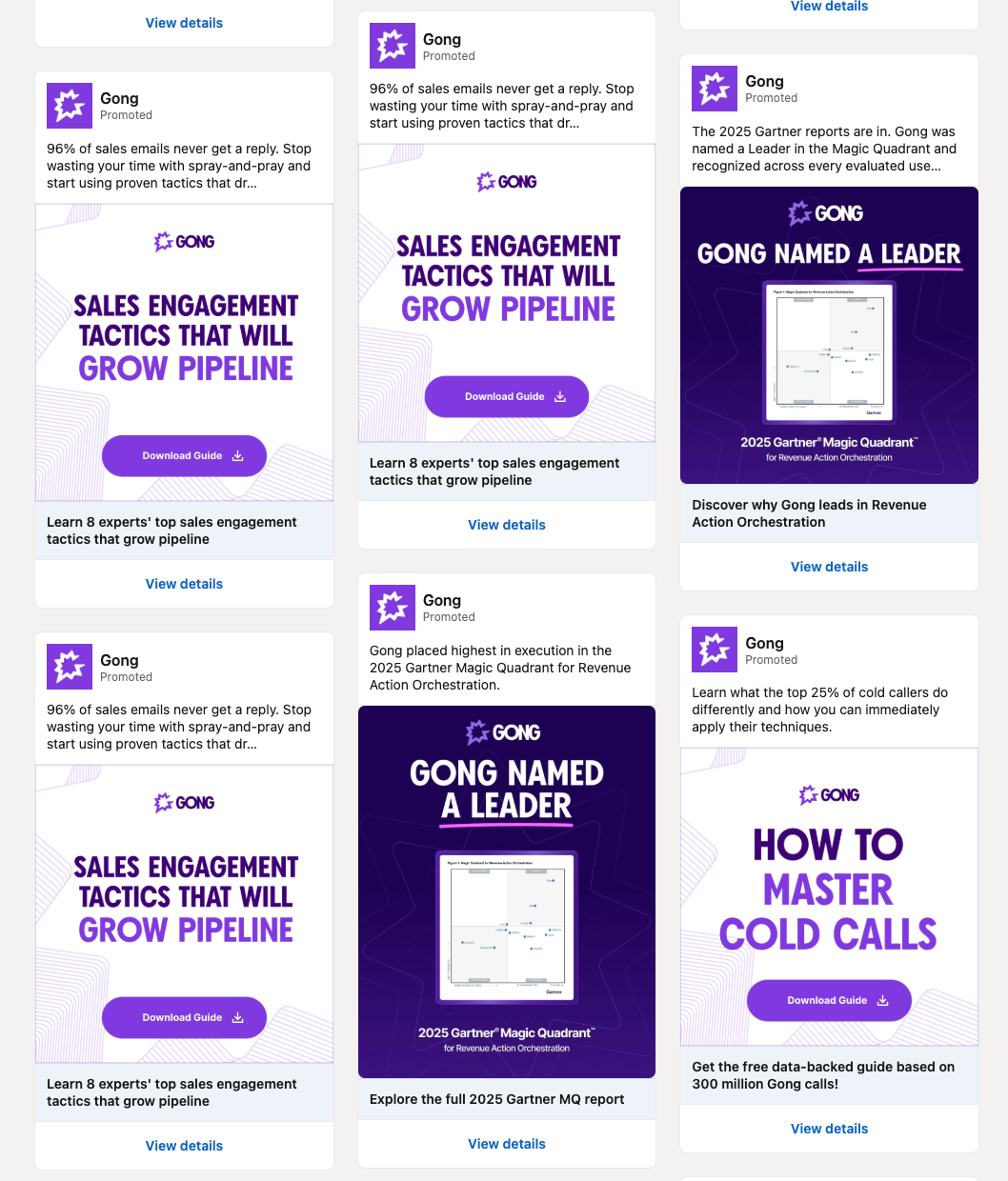
Examples from Gong's LinkedIn Ad Library showing educational downloads, a clear next step, and third-party recognition. These creatives illustrate messaging choices; the screenshot does not establish campaign performance.
From just these six ads alone you can see that Gong is implementing several of the best practices I introduced to you earlier:
- Clear and simple copy
- Benefit driven
- Avoid jargon
- Use negative space
- A clear next step
These ads are easy to read and comprehend. You know what to expect if you were to click on them. You’re not being sold anything, rather, you are being offered resources to download, or provided with basic information about the company, backed up by third party recognition. These ads are great ones for any SaaS company to emulate in their own LinkedIn Ads.
You can take your research in the LinkedIn Ad Library further by looking at several different brands’ ads and using AI to help you spot patterns among them. You can then inform your own strategy based on those findings.
LinkedIn as an Ecosystem Accelerator
Most SaaS teams think of LinkedIn as just another acquisition channel. But when LinkedIn is run through a trust-led system like the Rising TIDE Funnel, it stops behaving like a channel and starts functioning as essential infrastructure for your entire growth engine.
The real value of LinkedIn isn’t just in the leads it generates, it’s in the insights it reveals about your buying committee. Because LinkedIn sits so close to your buyers’ professional identity, every campaign becomes a learning loop that teaches you:
- Which messages resonate with decision-makers
- Which problems create the strongest engagement
- Which industries, roles, and segments respond best to you
Those insights don’t stay trapped inside the LinkedIn Campaign Manager. They ripple outward and improve everything:
Organic
Your best-performing ad angles can become your strongest content themes, grounded in real audience data, not guesswork.
Search
Watch for changes in branded and problem-based search as buyers become familiar with you. These patterns can suggest cross-channel effects, but they do not establish that LinkedIn caused the change.
Outbound
Sales can build on the same useful content and messages buyers encounter in your ads. Some prospects may already recognize the brand when outreach begins.
Sales
Use campaign insights to prepare sales conversations, address recurring objections, and test whether engaged accounts progress differently.
This is when LinkedIn stops being “just ads” and becomes an ecosystem accelerator that quietly lifts every other channel by making your brand more familiar, credible, and relevant.
Real-World Proof: When LinkedIn Becomes a Growth Engine
It’s one thing to talk about trust-led strategy in theory. It’s another to see what happens when SaaS companies actually apply it.
Across every engagement where we implement the Rising TIDE Funnel, the same pattern emerges: precision and trust consistently outperform volume and brute-force advertising. Instead of chasing more impressions, we worked with our clients to focus on reaching the right buyers with the right message at the right stage of the journey.
Here are two real-world examples of what that looks like in practice.
CASE STUDY | Financial SaaS: $2M in Pipeline in 90 Days
This B2B financial software company had already tested Meta and Google in an effort to scale demand. Meta delivered a high volume of low-quality leads. Google was so competitive that cost per lead became unsustainable.
The problem wasn’t traffic. It was signal quality.
Using LinkedIn Ads, we rebuilt their approach around the Rising TIDE Funnel. Instead of broad targeting, we applied tight audience segmentation and excluded irrelevant roles, industries, and company sizes. Every impression was intentional. And rather than relying on corporate-looking creative, we designed ads that were engineered to stop the scroll and deliver messages in a relatable way.
The result:
- $9,000 in ad spend
- 41 total qualified leads
- Over $2.05M added to the pipeline
- 28x return on ad spend, based on approximately $250,000 in closed revenue
- In three months, five new deals closed.
LinkedIn became the high-efficiency engine that other channels couldn’t replicate. By combining precise targeting, native-style creative, and airtight technical setup, the client turned expensive traffic into predictable, high-quality pipeline, proving that the right attention always outperforms more attention.
CASE STUDY | MarTech SaaS: 74% Reduction in MQL Cost
One of the largest MarTech companies in the United States came to us to help them revamp their campaign strategy and drive costs down. They were spending heavily on single-image ads driving to landing pages, hoping to generate MQLs. The results were painful:
- $906 per conversion
- $209 per lead
To help them, we didn’t change the audience. We changed the strategy.
Instead of pushing for immediate form fills, we shifted them into a trust-first Document Ad approach aligned with the Rising TIDE model:
- Educational content replaced product-heavy messaging.
- Prospects consumed value before being asked to convert.
- Lead capture became a natural next step, not a forced one.
The result:
- Cost per conversion dropped to $72 (↓92%)
- Cost per lead dropped to $54 (↓74%)
Same platform. Similar budget. Completely different outcome, because the funnel changed from “click first, convince later” to “educate first, convert naturally.”
→ Explore these case studies in more depth.
These examples highlight the core insight behind the Rising TIDE Funnel: LinkedIn doesn’t reward the loudest brands. It rewards the most credible ones.
Frequently Asked Questions About LinkedIn Ads for SaaS
Are LinkedIn Ads worth it for B2B SaaS?
They are worth testing when professional targeting helps you reach a valuable buying committee and your sales economics support the cost. Compare qualified opportunities and acquisition cost with your other channels, rather than deciding from clicks or form fills alone.
Which LinkedIn ad format should a SaaS company start with?
Start with the offer and the action you want. A single image ad can introduce one clear idea, a Document Ad can share a useful guide, and a video can explain a product or problem. Choose a manageable test and evaluate lead quality before expanding formats.
How long should you test LinkedIn Ads?
Allow enough time and spend to evaluate delivery, message response, and lead quality, then follow opportunities through your sales cycle. Agree on checkpoints and a spend cap in advance. Fix broken tracking or poor audience fit promptly; patience is not a reason to keep funding a test that cannot answer your business question.
Can you advertise demos to a cold audience?
Yes, particularly when the audience has an urgent problem and the offer is specific. Test it rather than assuming it will always work or always fail. For buyers who need more context, educational content and proof can make the later demo request more relevant.
Want Help from Experts in LinkedIn Ads for SaaS?
If you’re serious about making LinkedIn Ads a real growth channel for your SaaS business, the first step is building the right system. That means developing clear positioning, implementing strong tracking, utilizing a full-funnel strategy, and designing creative that actually reflects how buyers think and behave.
If you want help designing that system for your team, we’re happy to talk through what would make sense for your stage and goals. Reach out to us today.