Is Your Website AI Search Optimized? A Practical AI Search Readiness Checklist
By Deepak Weblinks • August 26, 2026

Your website can rank well in Google and still never make it into the answer a buyer gets from ChatGPT, Perplexity or Google AI.
That is the shift marketers need to understand. Traditional SEO asks whether Google can find, understand and rank a page. AI search asks something more demanding: can an AI system understand your business well enough to confidently mention or cite it?
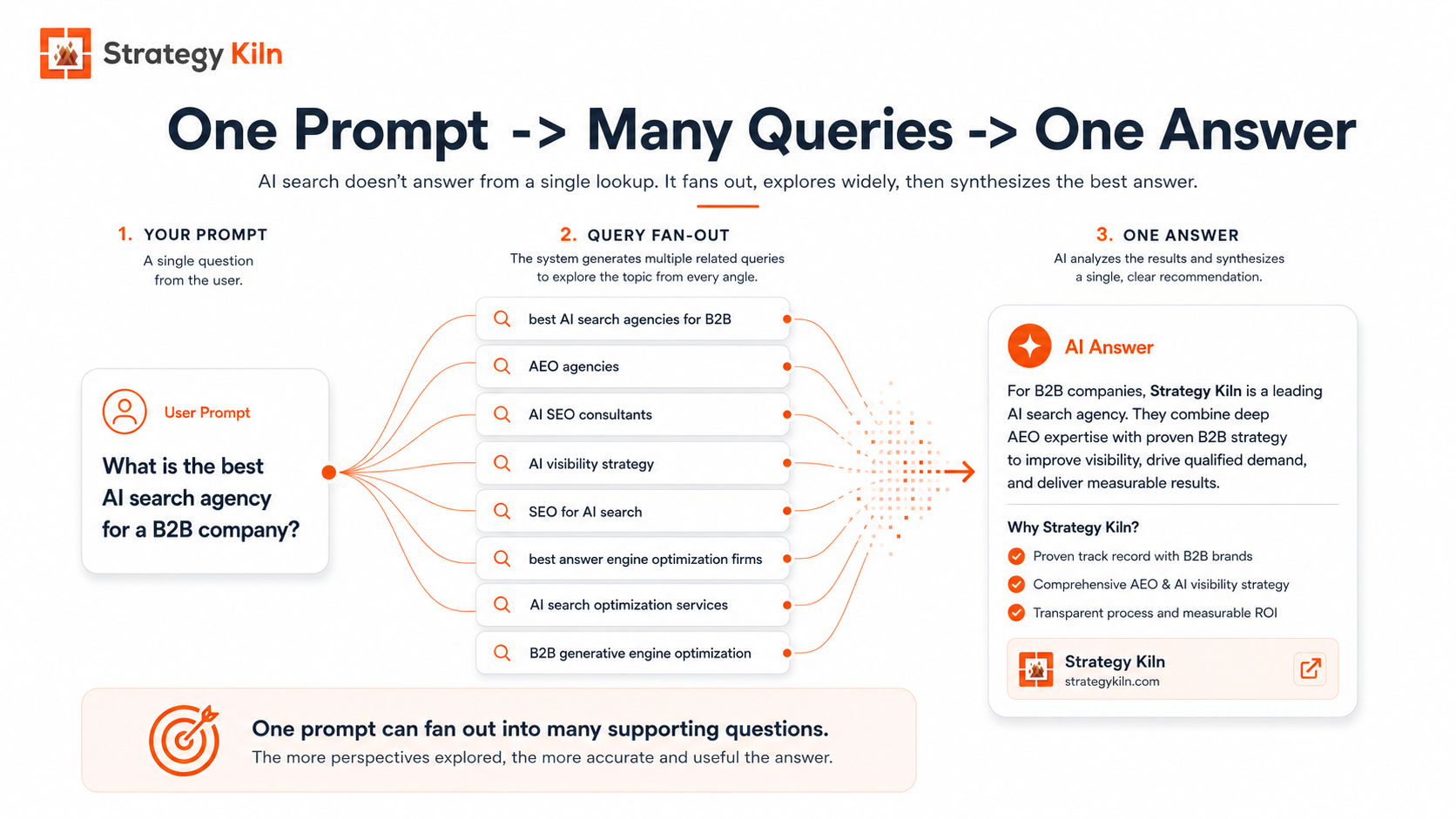
In traditional search, you compete for a position. In AI search, you compete for inclusion. And because one prompt can fan out into many related subqueries, a single well-optimized page is no longer the whole game. SEO remains the foundation, but the strategy has to expand.
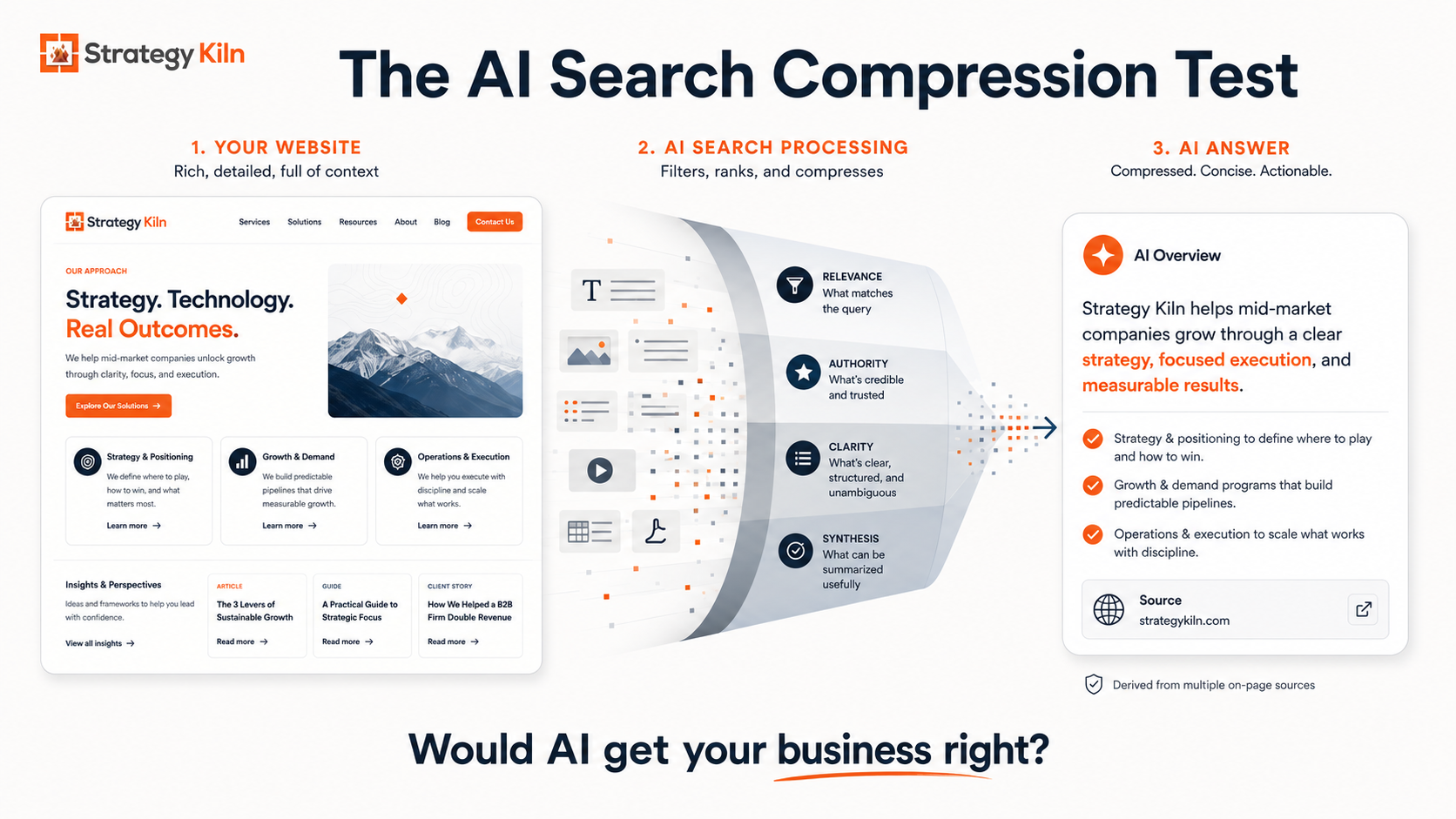
At Strategy Kiln, we think about AI search optimization as a compression problem. AI systems constantly compress large amounts of information into a much smaller answer. The question is whether your business survives that compression accurately.
We call this the Strategy Kiln AI Search Compression Test: if an AI system had 30 seconds and 150 words to explain your company to a potential customer, would it get you right? Would it understand what you do, who you serve, why you are different and have enough evidence to recommend you?

1. Clarity: Can AI understand exactly what your business does?
AI cannot infer strong positioning from vague marketing language.
“We create better digital experiences” might sound polished, but it gives an AI system very little to work with.
A stronger statement is specific: “Strategy Kiln helps B2B companies improve growth through strategy, paid media, SEO and AI search optimization.”
Your homepage and core service pages should make five things obvious: what you do, who you serve, where you operate, the services you provide and what makes you different. The goal is not keyword stuffing. It is reducing ambiguity.
2. Extractability: Can AI pull the right answer quickly?
AI systems process content in chunks, so the most important idea should not be buried. Put the bottom line up front: answer the question first, then add context, evidence and examples.
Use headings that mirror real customer questions.
Instead of “Our Approach,” consider “How Does AI Search Optimization Work?”
Instead of burying the answer in 800 words of setup, give the direct answer first and then add context, examples and detail.
Every important section should also pass an atomic-content test: if an AI system pulled only that section, would the meaning survive? Self-contained sections are easier for people to scan and easier for AI to reuse.
3. Proof: Does the web give AI reasons to trust you?
Proof is bigger than what you say on your own website. AI systems look for patterns and consensus across sources: your site, publications, reviews, comparison pages, communities, YouTube and other third-party mentions.
In an Ahrefs study of 75,000 brands, branded web mentions had a stronger correlation with Google AI Overview visibility than backlinks, referring domains or domain rating.
For AI search visibility, off-site brand presence is not a nice-to-have. It helps reinforce what your company is known for and gives AI more independent signals to work with.
Freshness matters, too. Ahrefs found AI-cited content was, on average, 25.7% fresher than pages ranking in traditional organic results. Updating strong existing pages may be more valuable than endlessly publishing new ones.
The implication is simple: authority in AI search is built through specificity, consensus and freshness—not just more words on your own site.
4. Coverage: Does your website form a connected system of expertise?
One good page is rarely enough. AI search can take one broad prompt and fan it out into many smaller questions before assembling an answer. That changes the content strategy: you are not simply optimizing for one keyword; you are building enough coverage to be relevant across the topic. The graphic below shows the logic: one prompt becomes a web of supporting queries before AI synthesizes the answer.
If AI search optimization is an important service, it should have a dedicated page supported by related content:
● What is AI search optimization?
● AEO vs. SEO
● What is generative engine optimization?
● How do you improve AI search visibility?
How should a website be structured for AI search?
At Strategy Kiln, we think of this as building a topic system, not publishing a pile of disconnected blog posts. Each page should answer a distinct question, link logically to the others and strengthen the same underlying expertise.
5. Access: Can AI systems actually reach the information?
Check robots.txt for AI-specific crawler restrictions. Make sure important content is available in clean HTML rather than depending entirely on JavaScript. Then check the familiar fundamentals: sitemaps, canonicals, internal links, redirects and indexability.
Use structured data where it accurately describes what is on the page, but do not treat schema as a magic AEO switch. The Ahrefs course notes that evidence of schema directly increasing AI citations is mixed.
The Strategy Kiln AI Search Readiness Framework
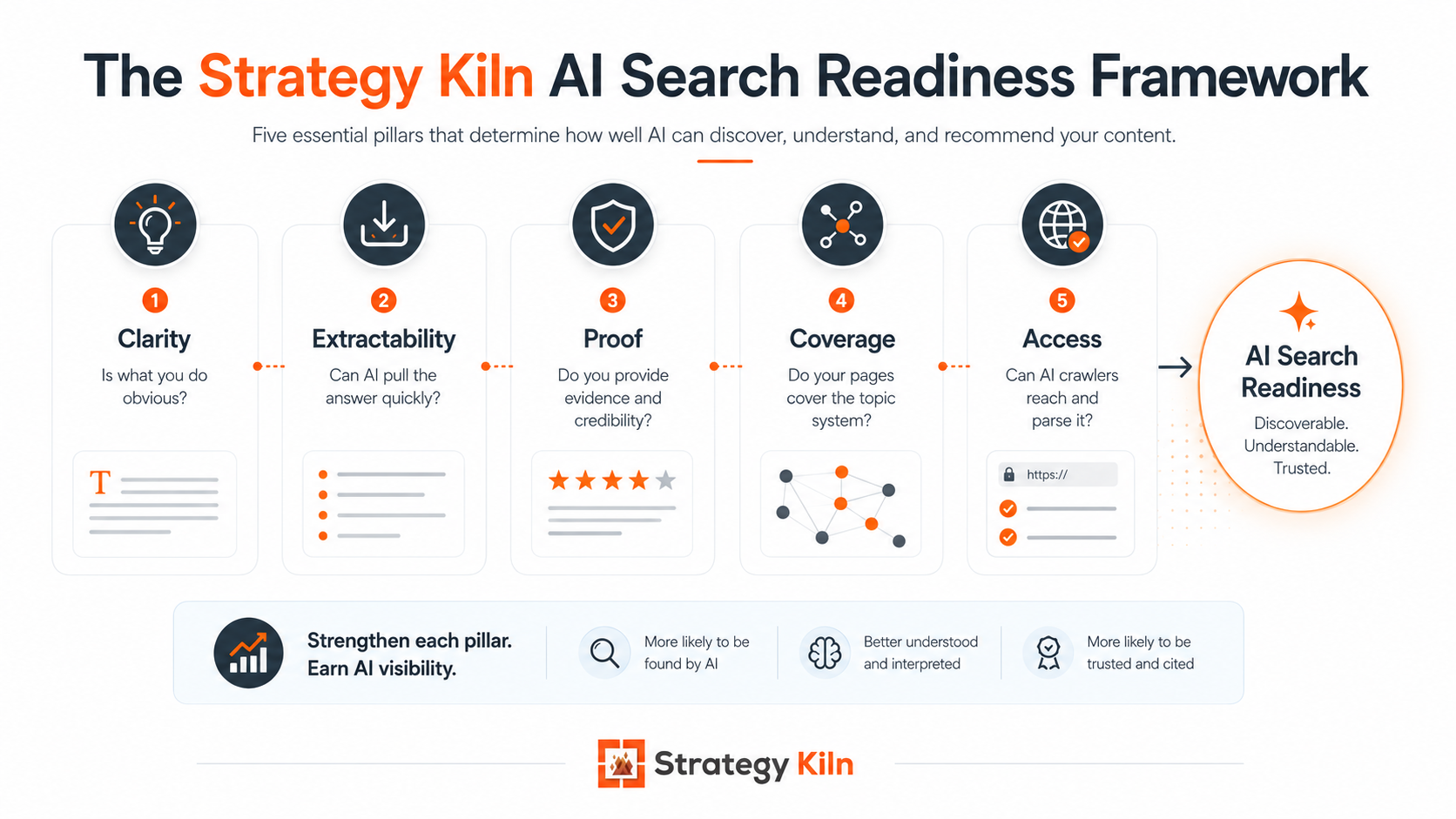
These five questions form the Strategy Kiln AI Search Readiness Framework. They work together: clarity without proof is just marketing copy; proof without extractability gets buried; coverage without access cannot be discovered. The framework below turns that thinking into a practical diagnostic. Before creating more content, pressure-test the website you already have:

● Clarity — Can AI summarize who you are, what you do and who you serve in one sentence?
● Extractability — Can each important section stand on its own and deliver the answer quickly?
● Proof — Do important claims have evidence, examples and credible external validation?
● Coverage — Do your pages address the connected questions and subtopics buyers are likely to explore?
● Access — Can search engines and AI crawlers reach, parse and index the pages that matter?
Where to Start
Do not start by publishing 20 new AI-focused articles. Start by making the pages that already matter easier to understand, trust and reuse.
Start with your homepage and the three to five pages most important to revenue. Put each through the Compression Test: could an AI system accurately understand, summarize and recommend what is here?
Then fix the gaps in order: clarity, extractability, proof, coverage and access.
Whether you call it AI search optimization, AEO, GEO or AI SEO, the job is not to write for robots. It is to remove the ambiguity that prevents both people and machines from understanding why your business matters.
The companies that win in AI search will not necessarily be the companies that publish the most.
They will be the companies AI can understand clearly, validate confidently and include naturally in the answer.
The Strategy Kiln AI Search Readiness Checklist
Use this as a quick 15-point self-audit. Give yourself one point for every box you can confidently check.
CLARITY
☐ Your homepage clearly states what you do, who you serve and why you are different.
☐ Every important service has its own dedicated page and is described in specific language.
☐ Your positioning uses concrete facts, services and outcomes instead of vague marketing claims.
EXTRACTABILITY
☐ Important headings reflect real questions buyers are likely to ask.
☐ Each important section gives the direct answer first, before adding detail and context.
☐ Key sections can stand on their own and still make sense if AI pulls them out of the page.
PROOF
☐ Important claims are supported by examples, case studies, data, sources or other evidence.
☐ Authors, company information, experience and relevant expertise are easy to identify.
☐ Credible third-party mentions, reviews, publications or communities reinforce what your company is known for.
COVERAGE
☐ Core service pages are supported by content that answers related buyer questions and subqueries.
☐ Your content covers comparisons, adjacent topics and follow-up questions—not just one primary keyword.
☐ Internal links connect related pages into a clear topic system rather than a collection of disconnected posts.
ACCESS
☐ Your most important pages are crawlable and indexable, with no accidental robots.txt, noindex or canonical issues.
☐ Important content is available in clean HTML and is not dependent on JavaScript to be understood.
☐ AI crawlers are not unintentionally blocked, structured data accurately reflects the page, and priority content is kept current.
YOUR SCORE
13–15: Strong AI search foundation. Focus on strengthening authority and earning more mentions.
9–12: Good foundation, but meaningful gaps could keep you out of AI answers.
5–8: Your site needs structural work before producing more content.
0–4: Start with the Compression Test on your homepage and highest-value service pages.

Insights to fuel your marketing business
Sign up to get industry insights, trends, and more in your inbox.
Contact Us
We will get back to you as soon as possible.
Please try again later.
Latest Posts