GOST Framework Explained with Amazon Example | Strategy Kiln
By Adam Fischer • May 16, 2022
Have you ever worked in a job where people were really busy but nothing seemed to get finished? Or where information never made it across departments—or even from person to person? A plan only helps when everyone can connect their daily work to the result the business needs.
What is the GOST framework?
GOST stands for Goals, Objectives, Strategies, and Tactics. It is a strategic planning framework that connects your long-term direction to measurable outcomes, choices about how to compete, and specific actions. Goals set the destination; objectives define success; strategies guide your choices; tactics put those choices into practice.
Do you believe in GOSTs? No, we’re not talking about the sheet-wearing phantoms that Bill Murray blasts with his proton pack. We’re talking about making your plan visible enough that people understand where they fit and what they are accountable for.
When teams stay busy without making progress, one or more parts of GOST may be missing or poorly communicated. Below, we’ll define each part, work through a hospital example, and show how an Amazon example connects corporate, business unit, and marketing plans.
Is the GOST model better than OGSM?
You’ve likely come across OGSM: Objectives, Goals, Strategies, and Measures. Both frameworks help connect direction with execution. We prefer GOST when teams need an explicit distinction between strategies and tactics, helping them avoid the pitfall of tactics with no real strategy behind them.
Neither model is automatically better for every team. The terminology also differs: in ArchPoint’s OGSM definition, the objective sets the broad direction and goals quantify success. In the GOST definitions below, goals are broad and objectives are measurable. Agree on the terms before building your plan.
Goals, objectives, strategies, and tactics: what is the difference?
One challenge with terms like goals, objectives, strategies, and tactics is that they’re often used interchangeably. Or, just as puzzlingly, they’re sometimes used to mean different things by different people.
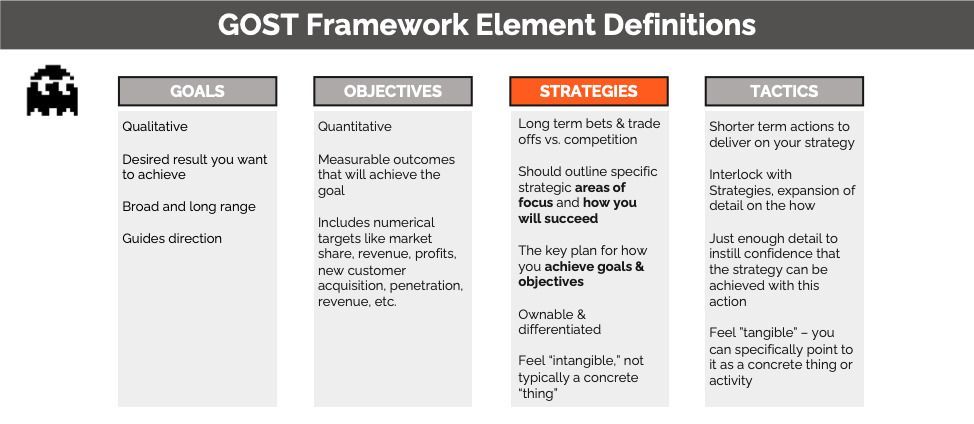
Here’s our guide to GOSTs—the definitions we use consistently throughout this article and on StrategyKiln.com.
| GOST element | What it means | Hospital example |
|---|---|---|
| Goal | The broad, long-term result you want to achieve. | Become the region’s first-choice pediatric care center. |
| Objective | A specific, measurable outcome with a deadline. | Increase patient satisfaction by 20% within 18 months. |
| Strategy | Your choice about where to focus and how to succeed. | Differentiate through a better experience for patients and families. |
| Tactic | A concrete action that puts the strategy into practice. | Send a survey after each visit and train front-line staff. |
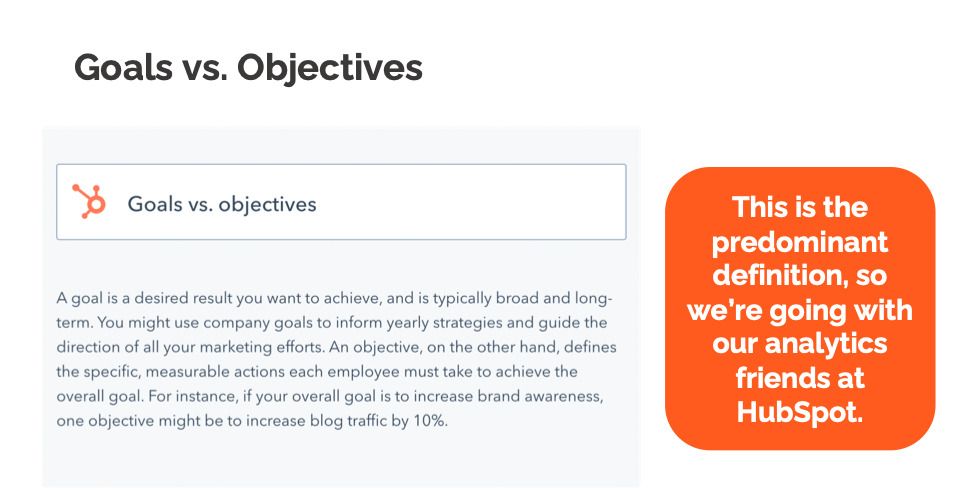
We’ll be using a similar definition of goals and objectives as our friends over at HubSpot, as depicted in this image:
Goals
We start by defining goals vs. objectives. Goals are the desired results that you want to achieve at a high level. They are qualitative, long-term and help guide your overall direction. For example, a hospital’s goal might be to be the first choice pediatric care center in the region —a big, broad, long-term goal that can help guide that company’s choices and actions.
Objectives
An objective is not the same as a goal. Objectives are quantitative, specific, measurable outcomes that will help you achieve a goal. Objectives often include numerical targets such as revenue, sales, and market share. Sticking with our hospital example, a possible objective could be to increase patient satisfaction by 20% within the next 18 months. Often, you’ll have several objectives underneath an overarching goal.
Strategy
A strategy is a plan of action for how you’ll achieve your long-term goals. Strategies typically aren’t tangible, which may be why people often struggle to define the term. Strategy isn’t targets or numbers or concrete actions. It’s your choice for where to focus to drive differentiation or lower cost, or both, and how you will compete in the market.
How can I tell if something is a strategy?
Strategy must be what differentiates you from the competition. A surprising litmus test to tell if you have a “real” strategy is asking – “could I say NO to doing this?”
For example, a hospital can’t say that one of their strategies is patient safety because it’s a given that patient safety is every hospital’s concern (let’s hope, anyway). Your strategy cannot be what everyone else is already doing well, unless you somehow deliver incremental customer value. A hospital could say that one of its strategies is to improve the patient experience. They don’t have to do it, but it’s something that could set them apart from other hospitals.
Tactics
Tactics are the specific, tangible actions that help you achieve your strategy. If your strategy is improving patient experience, for example, your tactics might include sending patients a survey after every visit, improving hospital food, or better training for front-line staff.
For a deeper examination, read our guide to strategies vs. tactics and how they work together.
Ever seen a GOST? Applying the GOST Framework with an Amazon Example
This holistic example should pull everything we’ve learned together and put it in context.
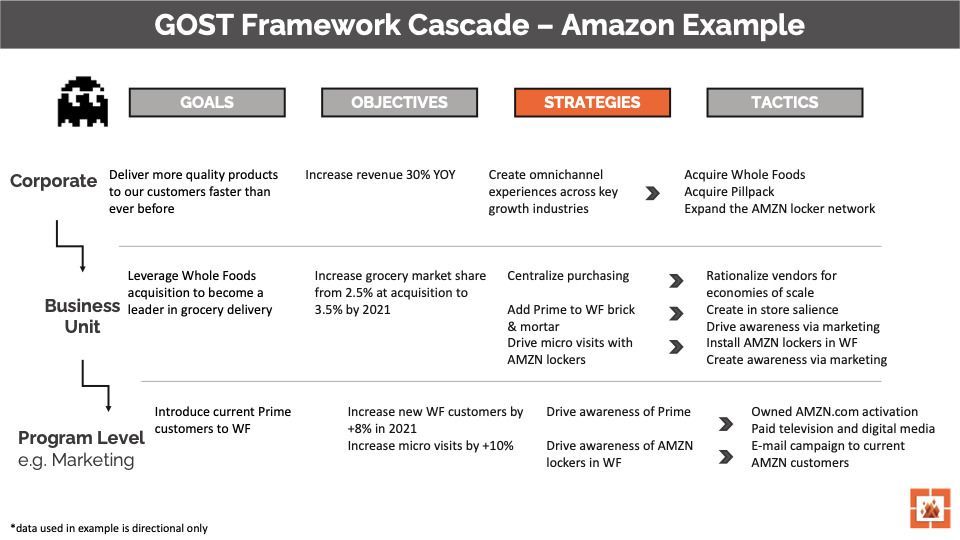
You can see from the diagram below that the GOST framework exists at different levels, with each level supporting the ones above it. You probably have an overarching goal at the corporate level that guides the entire company, then below that, you have a GOST framework for business units, and below that, you have GOSTs at the program level, for marketing, IT, operations, and so forth.
About this example: This is an illustrative historical exercise, not Amazon’s internal strategic plan or a statement of verified performance targets. The percentages and 2021 deadlines are retained from the original teaching example. They show how to write measurable objectives, not what Amazon promised or achieved.
Corporate Level
At the corporate level, naturally, your GOST is going to be broad. In this illustrative plan, in the case of an enormous company like Amazon, goals, such as “deliver more quality products to our customers faster than ever” are likely to be very big, with high level objectives such as, “Increase revenue by 30% year over year.”
Similarly, your strategy, which might be to “create omnichannel experiences across key growth industries” is quite broad, and the tactics that you’ll use to achieve that strategy, such as acquiring Whole Foods, acquiring PillPack, and expanding the AMZN Locker network, are big steps.
Business Unit Level
Now, these corporate strategies start to “cascade” down, informing GOSTs at the business unit level. Looking solely at the example of Whole Foods, the goal at the business unit level may be to leverage it into a leader in grocery delivery with an objective of increasing grocery market share from 2.5% at acquisition to 3.5% by 2021—a very specific, measurable outcome.
The strategies at this stage might include centralizing purchasing, adding Prime to Whole Foods brick and mortar stores, and driving micro visits with AMZN Lockers. Amazon doesn’t have to do these things to be a retailer, but these strategies are what differentiate it from other companies.
Tactics, of course, are specific steps that help achieve this strategy. At this level, they might include rationalizing vendors for economies of scale, creating in-store salience, and installing AMZN Lockers in Whole Foods stores.
Program Level
Now we cascade down to the program level—in this case, marketing, but IT, Operations, and many other departments will all have their own GOSTs that will support the business unit’s goals. In this example, marketing’s goal is to introduce current customers to Whole Foods, and its objective is to increase new Whole Foods customers by 8% in 2021 while increasing micro visits by 10%.
Its strategies for accomplishing this might include driving awareness of Prime and AMZN Lockers in Whole Foods, while the tactics that support those strategies could include advertising and email campaigns.
Now you can say you’ve seen a GOST! Are your GOSTs clear and transparent—or shrouded in mystery? We encourage you to do a little GOST hunting in your own place of work.
Thank you for accepting all the puns from this article.
The practical lesson: Each level should support the one above it. An acquisition can be a corporate tactic, while the acquired business needs its own strategy and operating tactics. What matters is whether the choices and actions connect to a measurable result.
How to use the GOST framework in your strategic plan
- Choose one goal. Describe the result you want and why it matters to the business or customer.
- Set measurable objectives. Record a baseline, target, deadline, and owner. Specify whether a percentage means relative growth or percentage points.
- Make strategic choices. Explain where you will focus, how you will create value, and what you will choose not to pursue.
- Assign tactics. Give each action an owner, resources, and a due date. Every tactic should support a strategy.
- Review the connection. Check progress regularly. If activity is increasing but your objectives are not improving, revisit the strategy and tactics.
Build your own GOST plan
Copy this simple GOST template into your planning document and complete one connected chain before adding more:
- Goal: We want to become or achieve ______.
- Objective: Move ______ from [baseline] to [target] by [date]. Owner: ______.
- Strategy: We will focus on ______ to create value by ______. We will not pursue ______.
- Tactics:[Owner] will complete [action] by [date], using [resources].
- Review: We will measure ______ and review progress every ______.
Explore our GOST framework resource, or use Strategy on a Page to bring the plan together in one place.
Need help turning a busy team’s activity into a clear plan? Talk with Strategy Kiln about your GOST framework. We can help you connect the goal, measures, choices, and work your team needs to deliver.

Adam Fischer is a marketer with 10+ years of experience in brand management and digital marketing. He’s challenged conventional assumptions and taken bold moves to drive growth for small businesses like Dogeared Jewelry to multi-billion-dollar companies like CVS Health and Nature Made Vitamins. He leverages his B.S. in Philosophy from Northeastern University to ask questions that get to the heart of business issues, while his MBA in Marketing from the Thunderbird School of Global Management at ASU translates management philosophy into real strategic growth.
There is also a video that accompanies this post...
About this Author:
Adam Fischer is a marketer with over ten years of experience in brand management and digital marketing. He’s challenged assumptions and taken bold moves to drive growth in roles at small businesses like Dogeared Jewelry and multi-billion-dollar companies like Nature Made Vitamins and CVS Health. His B.S. in philosophy from Northeastern University helps him ask questions that get to the heart of business issues. His M.B.A. in marketing from the Thunderbird School of Global Management at ASU helps him thinking strategically about driving brands and growth.
GOST framework FAQs
What does GOST stand for in strategic planning?
GOST stands for Goals, Objectives, Strategies, and Tactics. The framework connects a broad ambition with measurable results, strategic choices, and the actions needed to carry them out.
What is the difference between a goal and an objective?
In this GOST model, a goal describes the broad result you want to achieve. An objective makes progress measurable with a target and a deadline. “Become the preferred pediatric care center” is a goal; “increase patient satisfaction by 20% within 18 months” is an objective.
What is the difference between a strategy and a tactic?
A strategy is a choice about how you will achieve your objectives and create value. A tactic is a specific action that carries out that choice. Differentiating through patient experience is a strategy; launching a post-visit survey is a tactic.
Can a small business or marketing team use GOST?
Yes. Start with one goal and a short list of measurable objectives, strategies, and tactics. A marketing team should connect its plan to the business goal, so campaigns and channel activity support a defined result rather than becoming ends in themselves.
How often should you review a GOST plan?
Choose a review schedule that fits your planning horizon and the speed of your market. A practical starting point is a monthly check on objectives and tactics, with a quarterly review of strategic choices. Revisit the plan sooner if customer needs, resources, or competitive conditions change.

Insights to fuel your marketing business
Sign up to get industry insights, trends, and more in your inbox.
Contact Us
We will get back to you as soon as possible.
Please try again later.
Latest Posts