Why is strategic thinking so hard?
Strategic thinking is the ability to take a situation apart, see which relationships matter, and use that understanding to make a choice under uncertainty. Your experience shapes what you notice. The harder part is explaining why your choice makes sense, what you’re willing to give up, and what evidence would change your mind.
Imagine you’re running IBM in 1993. Its divisions compete with each other, and customers want the freedom to buy from rival suppliers. Do you break the company up or keep it together? A vision of profitable growth could support either answer. You face a version of that problem whenever two people in a meeting agree on the goal and want to spend the same dollar in different ways.
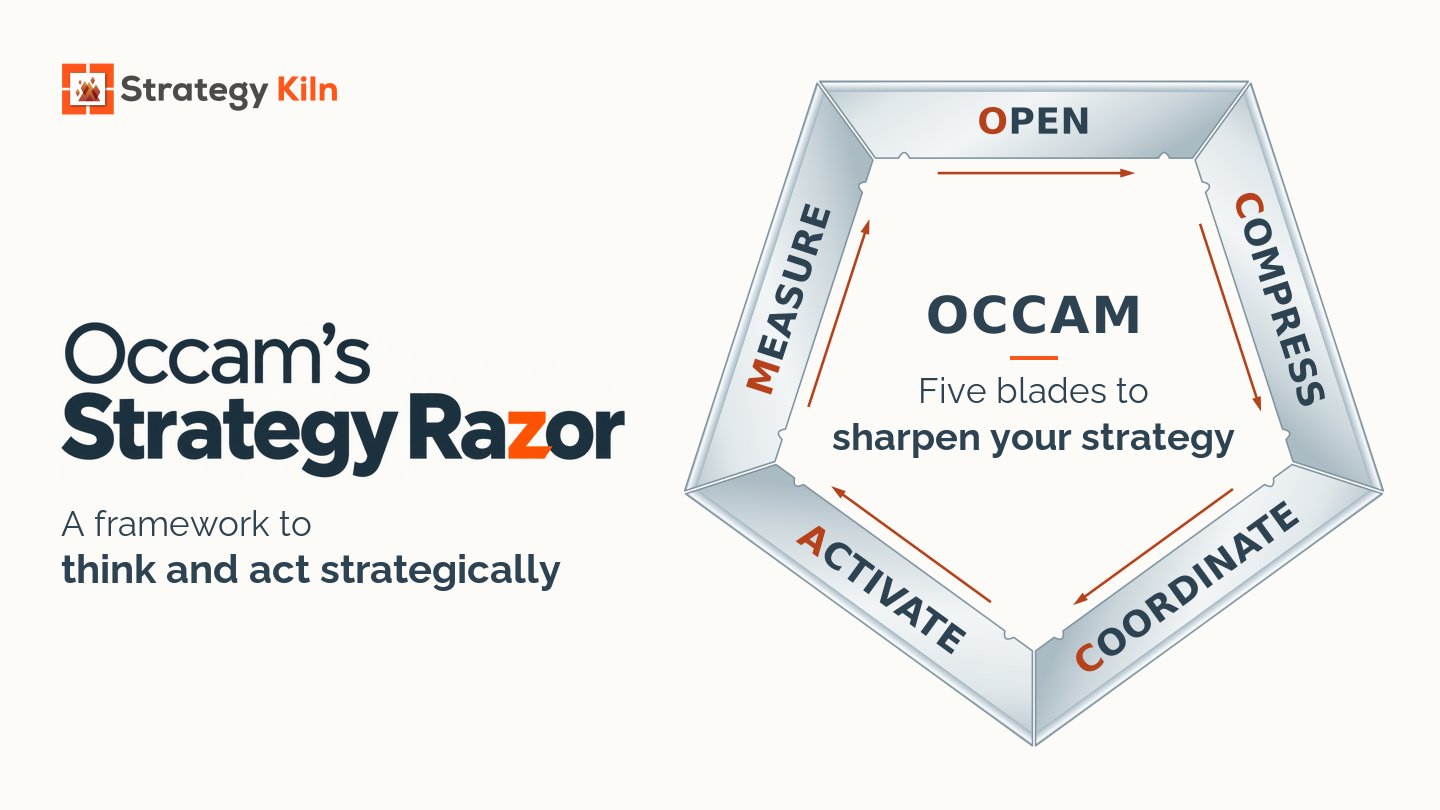
My view is that strategic thinking is deeply personal. Two people can look at the same facts and see different possibilities. Occam’s Strategy Razor is the five-question strategic thinking framework I developed at Strategy Kiln. It helps me explain how I reached a decision so my team can challenge the reasoning and test the choice.
What are the five questions in Occam’s Strategy Razor?
- Open. What have I seen firsthand, and what am I assuming?
- Compress. Which explanation would change my decision, and what would have to be true?
- Coordinate. Whose help do I need, and what do we need to agree on?
- Activate. What’s the smallest useful test of this choice?
- Measure. What result would make me continue, change course, or stop?
Each question calls for a different strategic thinking habit. Open asks me to stay curious long enough to see a pattern. Compress asks me to decide what that pattern means. These are the two blades I return to most. To see why, look at a drawing Kenichi Ohmae published in the 1982 English edition of The Mind of the Strategist.
What three identical squares taught me about strategy
I first read Ohmae around the time I started my MBA. I’ve forgotten plenty of what I underlined in business school. I can still picture this page. Each column starts with the same square. Watch what happens to its edges.

Kenichi Ohmae, The Mind of the Strategist (McGraw-Hill, 1982), figure 1–1, “Three kinds of thinking process.” Photograph of my copy.
In the first column, mechanical systems thinking breaks the square into regular pieces. You can study each piece and see how to put the box back together. I’d want that kind of thinking from someone diagnosing a machine. In the middle column, intuition takes you straight to a point. Experience can tell you where to look almost instantly. It can also make the first familiar detail feel more important than it is.
Now look at the third column. The edges are jagged. Pieces that once touched have come apart. You can turn one and see a relationship you couldn’t see inside the original square. This is my favorite depiction of strategic thinking because it captures the moment after you’ve done the analysis. You have pieces on the table and no picture on the box. Someone still has to decide what they add up to. Ohmae’s book
A person I admire, whom I call Mr. Strategy (he hates that), calls this conceptual thinking. He asks me to suspend what I think I know long enough to notice an inconvenient fact. That sounds easy until the assumption in question is mine. If I walk into a customer interview certain the problem is price, I can leave with six pages of notes about price and never learn why the buyer chose someone else.
Two Fischers, one chessboard
The strategy-and-chess metaphor is about as banal as naming your dog Fido. But my last name is Fischer. With a c. I think that buys me one Bobby Fischer example.
Put me in Bobby’s chair for the sixth game of the 1972 world championship against Boris Spassky. It’s White’s turn. See that black pawn on a6? I did, too.
Adam Fischer (the author)

I’d take the pawn on a6 with my bishop. “Free pawn!” Wrong move, Fischer.
Bobby Fischer (the grandmaster)

He pushed his pawn from e3 to e4. He took nothing. Look at the path that opened for his queen.
Fischer–Spassky, Reykjavík, 1972, game six. Four moves later, Bobby’s queen followed the long arrow to h3, near Spassky’s king.
I was asking, “What can I take?” Bobby’s move makes me ask, “What could my other pieces do if I moved this one?” Mikhail Tal’s notes on the game show how that pawn push helped White build an attack.
That’s what I see in Ohmae’s third square. Bobby and I can look at exactly the same position. I notice a piece I can take. His move makes me notice a relationship I missed between the pawn on e3, the queen on a3, and the king across the board. When I built Occam’s Strategy Razor, I wanted a way to catch myself in that first reading and give the second one a chance.
From Ohmae’s drawing to Occam’s Strategy Razor
Ohmae’s drawing gives me a picture of the thinking. The first two blades give me a way to practice it. Open gives an inconvenient fact room to change how I read a situation. Compress asks me to choose the interpretation I’m prepared to act on and say why.
Open • What’s happening?
Stay curious. Healthy optimism means believing there may be a better explanation than the one everybody accepts. When someone says, “We lose on price,” I want to learn why that sounds true to them. Then I zoom out. What else was happening in the buyer’s business when they made the decision?
Practice asking why. Ask someone to walk you through the last lost bid. Gather the quote, the buyer’s feedback, and the promised delivery date. Compare them with a win and another loss. Where does the pattern repeat? Which case breaks it? That’s analysis you can do before you settle on an explanation. For a wider view, I use a 5Cs assessment to look across customers, competitors, the company, collaborators, and context.
Compress • What are the critical success factors?
Bring focus and the courage to choose. Intuition can draw your attention to a detail. Critical thinking helps you judge how much weight it deserves. The hard part is deciding which factor matters enough to change what you’ll do, even while some uncertainty remains.
Practice making your reasoning visible. Try saying, “I’d choose ___ over ___ because ___.” Suppose the buyer paid more for a competitor who guaranteed delivery before a plant shutdown. Timing might outweigh price for buyers facing that deadline. Would you put money into reliable delivery and give up a discount? Check a second time-sensitive purchase before you make that bet.
I borrow a question from Roger Martin here. What would have to be true? Write down the condition the choice depends on, then ask what you could observe if that condition were false. That’s the discipline I associate with Occam’s razor. When two explanations fit the evidence equally well, favor the one that asks you to assume less. An awkward fact is a reason to reopen the question. Martin on testing a strategic choice
Would you have kept IBM together in 1993?
When Lou Gerstner became CEO, plans to break up IBM were already under way. Smaller product companies might move faster. Customers could buy the hardware and software they liked from each vendor. Seen from inside a product division, there was a good case for a split.
Gerstner had sat on the other side of the table at American Express. He recalled that when a credit-card data center installed a single machine from IBM competitor Amdahl, IBM withdrew support for the facility. Put yourself in that customer’s chair. You want the freedom to buy the right machine. You also want someone to take responsibility for getting the whole system to work. Gerstner’s account, as reported by Wharton
If you wanted one partner to make the system work, whom would you hire? An independent integrator has a real advantage. It can recommend any vendor without sacrificing a hardware sale of its own. Or you could hire an intact IBM. Its product engineers and service teams could work on the same problem, and one company could take responsibility when the system fails. Which partner would you trust with your data center?
That’s the judgment I’d want on the table during Compress. The need for integration leaves both options open. Keeping IBM together makes sense if access to its engineers helps solve customer problems and the company earns enough trust to recommend a rival’s machine. If product incentives keep getting in the way, independence starts to look like the stronger offer.
Here’s how I’d put the choice into a strategic plan. Where to play? Pursue large enterprises running critical systems across several suppliers. How to win? Take responsibility for the system from installation through support, even when another vendor gets the equipment sale. A customer buying one standalone machine has much less reason to pay for that breadth.
What would have to be true? The buyer would have to trust IBM to recommend the best mix of equipment. IBM’s product teams would have to help fix problems that crossed division lines. I’d ask a prospective customer to describe their last multi-vendor outage. Who figured out the cause? Who had authority to fix it? Which part would they have paid one partner to handle? Those answers would help me decide which bet to make.
Gerstner kept IBM together. IBM went on to offer solutions that could include competitors’ products. That was the choice he made. The questions above are how I’d test its logic. What stays with me is how his time on the customer’s side changed the meaning of that Amdahl machine. One lost hardware sale exposed a business IBM might win. Gerstner’s interview with the International Finance Corporation
How a strategic choice becomes a plan people can carry out
“We’ll take responsibility for the whole system” is a choice a CEO can announce. Imagine being the account leader the next morning. The best proposal for your customer includes someone else’s hardware. Your compensation depends on selling your company’s machines. Whose promise are you supposed to keep? This is where planning and leadership enter the picture. Here’s how I’d use the remaining blades with that team.
Coordinate • Where are the synergies?
Be flexible about how people get there. It takes empathy to understand why a product manager might resist a proposal that makes sense to the customer. It takes foresight to raise that conflict early. You earn the right to persuade someone by showing you understand what you’re asking them to give up.
Practice tracing one decision across teams. Put an account lead, a product lead, and a services lead around one customer proposal. Ask each what they can contribute, what they need from the others, and who gets credit if the customer renews. If recommending a rival’s machine helps the account but costs the product lead a sale, give them a chance to settle who can approve it and how both teams will be judged.
Activate • Will my plan deliver my objectives?
Take initiative and pay attention to the details. Wanting to win gives a launch energy. A willingness to find out quickly that you’re wrong keeps that energy useful. Before you ask a whole team to commit, look for one account where you can deliver the promise and learn from the outcome.
Practice rehearsing the first failure. For a customer who uses several vendors, name the person who owns the first installation. Ask, “If a supplier misses the installation date, who can get an engineer and replacement equipment to the customer?” Secure that person’s time and authority, agree with the buyer on what counts as a working system, and run the test.
Measure • How can we improve?
Be patient with results and tenacious about learning. An analytical mindset starts with remembering what you expected. Resilience is being willing to look closely at a disappointing result. Give the test enough time to be fair, then look for one change that would make the customer’s experience better.
Practice comparing the promise with the experience. Winning a bid tells me the promise was attractive. At the review, I’d put our prediction beside the buyer’s account of the first outage. Suppose we promised one point of contact, and the buyer still spent a day calling three vendors. Sales can count a win. The buyer is still doing the job they hired us to do.
That takes me back to Open. I’d reconstruct that incident with the buyer. If everyone knew what had failed but nobody could authorize a repair, my revised hypothesis would be that the buyer needs one person with decision authority. I’d give a service lead that authority on one account, then check who had to chase whom during the next incident. A result from Measure has changed the problem, the plan, and what I’ll count as success.
That’s the connection I care about. Strategic thinking produced a judgment about what the customer valued. Strategic planning turned it into a choice about which accounts to pursue, what to offer, and how to test it. Strategic leadership meant backing the account team when the best answer for the customer cost a division revenue. Each one asks something different of you.
What strategic thinking looks like on a Tuesday morning
Most of us won’t decide whether to split up IBM. We do get requests that arrive with the diagnosis already attached. Suppose a sales manager asks you to train twelve reps to update the forecast. Eleven reps have left the forecast field blank in the CRM. Then one of them shows you the spreadsheet all eleven update for their manager every Friday.
Would you book the training? My Applications of Strategic Thought grid helps me decide how much thought this request deserves. Read across for the time horizon and up for the depth of thought. The same forecast can put work in all four squares.
| Depth of thought | Immediate | Longer term |
|---|---|---|
| Deep | Reflective Ask which number the manager used last Friday and why. | Deeply strategic Decide which deals should count toward next quarter’s inventory purchases. |
| Shallow | Execution focused Send the verified forecast for today’s meeting. | Conveyor belt projects Schedule the agreed weekly forecast updates for the quarter. |
Start with this morning. If Operations needs a number you’ve already verified, send it. That’s the execution-focused square. The training request belongs one square up. Before I book twelve calendars, I’d ask the sales manager, “Can you show me a deal you discussed last Friday? What did you do with it?” Suppose the manager used the spreadsheet to spot a promising deal that needed coaching. Now I know why the reps keep it current. That fifteen-minute conversation is reflective work. It’s how I’d use Open on a Tuesday.
Now look a quarter ahead. Once everyone agrees who updates the forecast and when, putting thirteen Fridays on the calendar is a conveyor belt project. The deeply strategic choice is deciding when a sales opportunity is firm enough for Operations to buy inventory. Count it too soon and cash sits on a shelf. Wait for a signed order and the customer may go elsewhere.
Here’s where I’d use Compress. My hypothesis is that Sales and Operations can share one deal record while using different signals to act. This Friday I’d test that with one deal. Can the sales manager see that the rep needs help, and can the buyer tell whether to order stock? The answer tells me whether we need training, a change to the forecast, or both.
Try the razor on one decision you own
Pick a decision that’s actually waiting for you. Write down the answer you were ready to give. Then write down one fact someone with a different view would want you to explain. These five questions will help you carry that thought as far as the decision deserves.
The decision I own is …
Open. What have I seen firsthand? What fact would change my mind?
Compress. What must be true for this choice to work? What will I give up?
Coordinate. Whose help do I need? What do we need to agree on?
Activate. What small test will I run? Who takes the first step, and when?
Measure. What result would make me continue, change course, or stop?
My decision is … Who owns it? When will we review the result?
Download the editable text worksheet or work through the canvas in Miro.
When you come back to the decision, keep the first answer beside the one you acted on. What changed your mind? At IBM, the difference between a lost hardware sale and an opportunity to integrate a customer’s system depended on whose chair you sat in. At your desk, it might be one spreadsheet you hadn’t seen. That’s why I start with Ohmae’s square. The judgment is yours. The value of the razor is that someone else can follow how you got there and help you see the piece you missed.
Strategic thinking FAQs
How is strategic thinking different from tactical thinking?
Strategic thinking asks what choice gives you a better chance of achieving an objective. At IBM, that was whether to compete as separate product businesses or as one integrator. Tactical thinking comes in when an account team decides how to staff a particular implementation. A detail from that work can also give you a reason to revisit the strategy.
Can I think strategically if I don’t manage a team?
Yes. Start with a decision you can influence. If your manager asks for more leads, follow the last ten requests for a quote. If several buyers never heard back, you have grounds to test whether faster follow-up would help before recommending more advertising.
How is Occam’s Strategy Razor related to Occam’s razor?
Occam’s razor favors the explanation that requires fewer assumptions when the evidence fits both equally well. I borrowed that discipline for Open and Compress. Coordinate, Activate, and Measure carry the resulting choice into work that other people can act on and assess.
How do strategic thinking, planning, and leadership fit together?
Thinking gives you a hypothesis about where to play and how to win. Planning commits resources and sets a test. Leadership helps people act on the choice when it gets uncomfortable. In the IBM example, the hard leadership question is who will back a seller who recommends a competitor’s machine.
How do I know when I’ve spent enough time in Open?
Try naming two plausible explanations, the decision each would lead to, and the evidence that favors one. If both explanations lead to the same low-risk action, you may know enough to act. If they imply different investments, investigate the fact most likely to change your choice.
How can I get better at asking strategic questions?
Follow the answer to your first question. When a colleague wants to replace a departing employee, ask which outcomes the team risks losing. Then ask which of those outcomes require a new hire. Asking the second question can reveal an option the job description hides. Ask Questions Like a Philosopher
Do I need to use all five blades every time?
Use the blade that addresses the judgment in front of you. If everyone agrees on the objective and two departments keep overruling each other, spend your time on Coordinate. For a strategic plan that will commit people and money for years, work through all five and revisit earlier answers as evidence changes.
How do I show strategic thinking at work?
Let a colleague hear what changed your recommendation. For instance, “I came in ready to schedule CRM training. Then I saw that eleven reps already submit forecasts in a spreadsheet. Before we train them, I want to find out which record managers actually use.” Your colleague can now challenge the evidence, the interpretation, or the action.