LinkedIn Hooks for B2B Thought Leaders | Strategy Kiln
By Adam Fischer • January 8, 2026
Hooks are one of those words that get used constantly, but rarely unpacked. Everyone agrees the opening matters, yet most conversations stop at
what to write instead of digging into
whycertain hooks work, what psychology they’re tapping into, and how to create hooks that are high-value, credible, and actually earned. I wanted to go deeper than tactics alone. This piece brings together the fundamentals from classic copywriters like Ogilvy, Caples, and Sugarman with a modern, in-the-feed playbook drawn from creators I personally follow, like Jasmin Alić, alongside behavioral psychology and Jonah Berger’s STEPPS framework. It’s designed to cover how hooks work across text posts, static images, carousels, and video so you don’t just write better openings, but understand how to consistently earn attention and deliver on it across multiple mediums.
What Is a “Hook” and Why Does It Matter?
In copywriting, a hook is the attention-grabbing opening that stops your audience in their tracks and compels them to keep reading or watching. It’s often compared to a headline – in fact, ad legend David Ogilvy said, “When you have written your headline, you have spent eighty cents out of your dollar.” In other words, the success of your entire message can depend on the first few words.
On LinkedIn, this is literally true: only ~3 lines (about 200–220 characters) of a post are shown “above the fold” before a reader must click “See more” . If your opening doesn’t earn that click, the rest of your content might as well be invisible. A strong hook is your competitive advantage in a crowded feed.
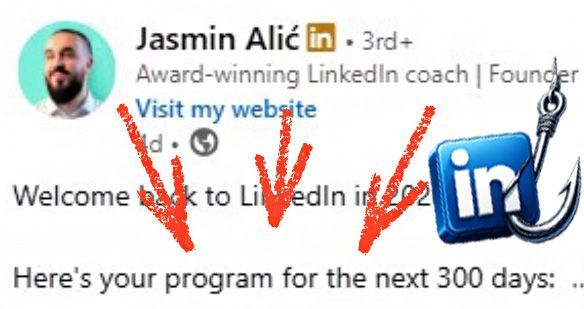
Hooks “get you in the room,” to borrow a phrase from LinkedIn creator Jasmin Alić. They pique interest and draw the reader in. But as Jasmin notes, a good hook is just the beginning – you must also “slam the door” behind the reader so they stay till the end. In practical terms, that means delivering on the hook’s promise and maintaining energy throughout your post (more on that later). First, let’s see how master copywriters have defined and used hooks to grab attention.
Classic Hook - Writing Wisdom from the Copywriting Masters
Long before LinkedIn and social media, copywriters in advertising were obsessed with the art of the hook, though they often spoke in terms of headlines or opening lines. Their timeless principles are highly relevant for crafting LinkedIn hooks:
- David Ogilvy – Open with Fire: Ogilvy famously advised, “When you advertise fire extinguishers, open with fire.” 🔥
- The idea is to start with drama and immediacy – something visceral that demands attention. In B2B terms, this might mean leading with a high-stakes problem or bold statement your target audience cares about. Ogilvy also emphasized clarity and simplicity in headlines, knowing you have mere seconds to hook the reader.
- John Caples – The Headline Is Everything: Caples, author of Tested Advertising Methods, showed through countless tests that an ad’s headline (i.e. its hook) is often the single determinant of success.
- “The success of an entire advertising campaign may stand or fall on what is said in the headlines,” writes Caples. He taught that a great hook should make an offer clear and appeal to the reader’s self-interest immediately. In practice, this means your LinkedIn hook should quickly answer “What’s in it for the reader?” or promise a benefit that matters to them.
- Joseph Sugarman – The First Sentence = The First Step Down a Slide: Direct marketing legend Joe Sugarman famously said the sole purpose of the first sentence is to get the reader to read the second sentence.
- He taught copywriters to use a short, intriguing opening line that “opens a curiosity loop”. For example, Sugarman might start with a teaser like “Picture this.” or “This is the truth.” – something easy to read that creates an open question in the reader’s mind . Each sentence should flow naturally into the next, almost “slippery” in momentum. This cascading interest is exactly what a LinkedIn hook should spark: a quick, curious read that makes clicking “See more” irresistible.
- Classic Formulas (AIDA and More): Traditional copywriting frameworks all begin with grabbing Attention. The AIDA model (Attention–Interest–Desire–Action) puts Attention first for a reason – without it, nothing else lands.
- Copywriters often used tactics like surprising facts, questions, or bold claims to get attention. Claude Hopkins and Eugene Schwartz wrote about identifying an exciting “Big Idea” or drama inherent in the product/problem to lead with. Even Claude Hopkins in the early 1900s knew an ad’s opening must arrest the reader’s gaze. In LinkedIn terms, this could be a startling industry statistic, a provocative question to your niche, or a contrarian statement that challenges common wisdom. The hook is where you flag down your target reader and say, “Hey, this is about you – and it’s important.”
- “Don’t Be Boring” – Say Less to Hook More: The 18th-century philosopher Voltaire quipped, “The secret to being boring is to say everything.” The best copywriters take this to heart.
- A hook is about teasing, not telling everything upfront. If you give away your entire message in the first sentence, the reader has no reason to continue. Instead, great hooks withhold just enough information to stir curiosity or tension. They promise value without fully delivering it in the preview. As modern copywriter Chip Heath puts it, “Shift from ‘What information do I need to convey?’ to ‘What questions do I want my audience to ask?’” . A hook should plant a question that the reader needs answered – essentially making them lean in and continue reading for the payoff.
In summary, the old masters teach us that a hook must be clear, impactful, and centered on the reader. It should
hit a pressure point (a pain, desire, or curiosity) in as few words as possible. Now, let’s explore the psychology behind why certain hooks work, and how we can apply those principles on LinkedIn.

The Psychology Behind Effective Hooks (Curiosity, Emotion, and Value)
Grabbing attention is not just an art; it’s science. Human brains are wired to notice certain triggers and to seek resolution to curiosity. Great hooks exploit these psychological tendencies:
- Curiosity and Open Loops: A well-crafted hook often creates a knowledge gap in the reader’s mind – they realize there’s something they don’t know yet and they want to find out. This is sometimes called the curiosity gap. When your LinkedIn post starts by alluding to an intriguing story or a promise (“I discovered a strategy that doubled our leads – and it’s not what you think…”), it sets up a question that the reader feels compelled to answer by reading on. Psychologically, people have a hard time leaving questions unresolved – this is related to the Zeigarnik effect (we remember uncompleted tasks). By posing a question (explicitly or implicitly), your hook leverages the reader’s innate desire for closure. Your first lines should make readers ask themselves, “What happened? How so? Tell me more!” . For example, starting a post with “Yesterday, my product demo completely failed – and it was the best thing that happened to our team.” immediately raises questions that beg for an explanation.
- Referencing the Zeigarnik effect (uncompleted tasks bug us), this psychological trigger has widespread application. While working on paid media at a tech company called IntelyCare, I developed a retargeting campaign to show nurses who applied with IntelyCare exactly where they were in the process. By providing a visual of what they had accomplished in the application, what the gaps and remaining tasks were, and really punching up how this was unfinished and would only take a few minutes to get done, we were able to get applicants to remember the uncompleted task and take action to get the application completed.
- Emotional Arousal: Emotions are attention magnets. Jonah Berger, in his bestselling book Contagious: Why Things Catch On, notes that “When we care, we share.” Content that evokes high-arousal emotions (awe, anger, fear, excitement, humor) tends to get more attention and is more likely to go viral. A hook that packs an emotional punch will stand out in a feed full of bland updates. This doesn’t mean every hook must be dramatic or shocking, but it should make the reader feel something: surprise, concern, hope, urgency, etc.
- On LinkedIn, a B2B hook might tap into professional emotions – pride, frustration, ambition, FOMO – for instance: “Quarter after quarter, 60% of salespeople miss quota. Here’s why it’s not their fault:” (sparking frustration or intrigue). Emotional hooks work not by manipulation, but by highlighting stakes that matter to your audience. If you trigger that “hey, that hits home!” feeling, you’ve got their attention.
- Relevance and Self-Interest: The brain is finely tuned to filter out irrelevant information. We pay attention to things that speak to our needs and interests (often unconsciously asking, “What’s in it for me?”). A powerful hook signals who the content is for and why they should care.
- One technique is to call out your audience directly. For example: “CTOs at SaaS startups, stop ignoring this cybersecurity gap…” or “Dear marketers: most of you are tracking the wrong metric.” By addressing the reader (or their role/industry) in the hook, you tap into their self-interest and signal that this content is tailored to them. I want to really stress this point; if you have high value solutions for a specific customer problem, you should call out who that specific customer is. This is a great opportunity to take a core concept and write several posts on LinkedIn for several different audiences, but personalizing your hooks and content for each unique customer.
- Another way to be instantly relevant is to mention a timely trigger – something top-of-mind for your audience. Jonah Berger’s framework notes that triggers (contextual cues) keep ideas sticky. In his book, Contagious, Jonah mentions how although no one openly admits to liking the song Friday by Rebecca black from 2011, it was a massive hit. Jonah relates the song’s success to how it was disproportionately played on Fridays and was top of mind for that day.
- For a B2B audience, referencing a current industry trend or news item in your opener can hook those who are already thinking about that topic.
- Novelty and Surprise: Our brains are hardwired to notice changes or anomalies – an evolutionary trait for detecting threats or opportunities. Hooks that defy expectations or present a contrarian idea often perform well. A LinkedIn hook that starts with “Everything you know about X is wrong.” or “We fired our top salesperson – on purpose.” contradicts assumptions and forces the reader to reconcile the surprise by reading on. Novelty also creates social currency – if something is surprising and insightful, people feel eager to share it to appear “in the know” . That’s why posts with “shocking but true” insights (backed by data or stories) tend to get high engagement. Just ensure the surprise is relevant and not mere clickbait – it should tie into a real insight of value.
- Specificity and Credibility: Specific details (numbers, names, data) in a hook can add credibility and intrigue. For example, “In 2025, I interviewed 100 CFOs about remote work – here’s what shocked me:” has multiple specific elements: a year, a quantity, a target persona, and a hint at a surprising finding. Specifics make a hook more concrete and believable (it’s not just fluff), and they pique curiosity because they promise an actual insight or outcome. In B2B, citing a statistic or result in your opener can be very effective: “Our startup cut customer churn from 8% to 2% in six months. The first thing we fixed was…” – a precise result that gets a B2B reader’s attention. Research shows that using numbers, timeframes, or naming a recognizable entity can boost hook performance . Just remember to hide the “how” – reveal the impressive result or claim, but save the explanation for after the click (e.g. end the hook on a colon or question to imply there’s more to come ).

The STEPPS Framework: Why We Share (and How It Informs Hooks)
Marketing professor Jonah Berger distilled six key factors that make ideas and content contagious – summarized by the acronym STEPPS . While STEPPS applies to overall content virality, understanding these principles can help you create hooks that not only grab attention but also encourage readers to engage and share. Here’s a quick look at each principle and how a LinkedIn hook might leverage it:
- Social Currency: We share things that make us look good or smart. A hook can tap into this by offering insider knowledge or a fresh perspective that readers will want to repeat. Example: “Hiring secret: One question Google’s HR chief always asks (and why it works):” – a hook like this makes the reader feel they’re getting privileged info (so clicking and sharing gives them social points).
- Triggers: This is about being top-of-mind. A hook referencing a ubiquitous trigger in your audience’s environment can latch onto something they frequently think about . For instance, “Every Monday morning, sales teams make this mistake…” uses the Monday trigger for professionals. The idea is to connect your content to a cue that routinely sparks recall. If your hook ties into a common scenario or daily ritual, it’s immediately relatable and attention-grabbing.
- Emotion: As mentioned, content that evokes emotion gets shared. Hooks that promise an emotional payoff – whether it’s inspiration (“This founder’s story brought our whole team to tears:”), excitement (“The most thrilling B2B campaign we tried this year:”), or even anger (“Why 70% of software buyers feel cheated – and how we can fix it:”) – will draw people in . High-arousal emotions in a hook act as a catalyst: if readers feel, they’re more likely to act (click, comment, share).
- Public: Berger means that people imitate what they see others doing – “built to show, built to grow” . For hooks, this can translate to bandwagon or popularity cues. E.g., “How Company X’s post got 1 million views – lessons learned:” or “The framework everyone in DevOps is talking about:”. By hinting that others are already interested or benefiting, you trigger a bit of FOMO – if everyone’s looking at it, I should too. Just be truthful; false hype can backfire.
- Practical Value: People share useful content. A hook that clearly promises practical value will reel in a time-strapped professional audience . This is where list and how-to post hooks shine: “5 proven steps to reduce cloud server costs by 30%.” The reader’s brain immediately thinks “This could help me.” B2B audiences love actionable insights, so emphasize concrete value in the hook (and deliver on it in the content). Words like “tips”, “strategies”, “framework”, “guide”, or explicit outcomes (e.g. “increase ROI”, “save 10 hours a week”) in your opener signal that reading further will be worth their time.
- Stories: Humans are wired for stories – we pay attention to narratives because we want to know how they end. A story-based hook can be extremely effective: it sets up a scenario that compels completion. For instance, “She was a first-time CEO who almost lost everything in year one…” or “I walked into my big presentation and nothing went as planned:”. These openings drop the reader into the middle of a story, creating suspense. As Berger notes, “Stories are vessels” – they carry your ideas along for the ride . On LinkedIn, sharing a quick narrative in the hook (especially a personal or case-study anecdote) can humanize your content and captivate readers. Just be sure the story is relevant to the insight you’re delivering, so it’s not just anecdote for anecdote’s sake.
In applying STEPPS to hooks, you don’t need all six in one hook (that would be overkill). But weaving one or two of these elements into your LinkedIn post openers can greatly increase their stopping power
and their shareability. For example, a hook might combine Practical Value + Emotion:
“Feeling burned out by endless Zoom calls? Here are 3 science-backed ways a VP of Engineering
reclaimed 10 hours a week (and got her team happier)…” – this promises useful tips (practical) and addresses an emotional pain (burnout), likely hitting a nerve with many B2B readers.

How to Use Hooks on LinkedIn: Strategies for Different Content Types
LinkedIn content comes in various formats – text posts, image posts, videos, carousels (documents), even newsletters and articles. While the core principles of a good hook remain the same, you should tailor your approach based on the medium. Below, we break down hook strategies by format, all within a B2B context:
Hooks in Text Posts (Feed Updates)
For text-only or text-centric feed posts (the classic LinkedIn status update), the hook lives in the first 1–3 lines of your post. These are what show before the “See more” cut, so they must carry the weight of attracting the reader. Key tips for text post hooks:
- Keep it Short and Snappy: LinkedIn gives roughly 210 characters before truncating the post . That often amounts to 1–3 short sentences. It’s wise to use line breaks and even one-sentence paragraphs to make the opener punchy and easy to scan . Dense blocks of text will turn readers off at a glance. Many top creators like to write 3 brief lines as their hook, sometimes even with one-word or one-phrase lines for dramatic effect (e.g. a single line saying “Unbelievable.”). This creates white space and visual breathing room in the feed.
- Start with a “Scroll-Stopper”: The very first line is critical – Justin Welsh, a prominent LinkedIn influencer who also has an awesome course on creating LinkedIn content, , says the first line is “more important than 95% of the rest of the post” . It needs to immediately resonate or intrigue. One proven tactic is to make a bold or contrarian statement that appeals to your target audience’s experience. For example, Justin often uses what he calls a “relatable enemy” as a scroll-stopper . He’ll pinpoint something his B2B audience dislikes or struggles with, and take a stance against it. In one viral post, he opened with: “The 9 to 5 is getting pummeled.” – a sentence that fired up readers who resent the traditional office grind. Think about your audience’s common pain points or villains (e.g. bureaucracy, inefficient processes, outdated advice) and consider opening by “throwing rocks” at that enemy . It instantly creates a “heck yes!” moment for readers who feel the same way.
- Ask a Provocative Question: Questions are natural hooks because when we see a question, our brain automatically starts searching for an answer. A well-placed question in your first line can entice the reader to pause and mentally respond – and then seek your post for the “official” answer or perspective. For B2B, this could be something like, “Why do 60% of product launches fail within six months?” or “CEOs, would you pay a 10% higher salary to cut employee churn in half?”. The question should be relevant and thought-provoking – ideally something the reader can’t answer immediately without context, which means they’ll need to read on. One technique is the two-part question hook: “Do you ever feel ___? Have you noticed ___?” This can validate the reader’s experience in the first question and then broaden or surprise them with the second.
- Use a List or Numbered Promise: List posts are very popular on LinkedIn, and starting your hook by signaling a list or a specific number of tips can draw attention. For example, “3 lessons I learned from losing a big client last year:” or “5 trends in AI that every healthcare CIO should know:”. The number in brackets or numeral form stands out visually, and it also tells the reader your post is structured (which busy professionals appreciate). Just make sure the listed items themselves are compelling and not generic. A twist like “…and #3 is counterintuitive”in your hook can tease that the list contains a surprise, further increasing curiosity.
- End on a Cliffhanger or Teaser: However you start your hook, consider ending the visible part with a “cliffhanger” punctuation – typically a colon or an ellipsis or a single tantalizing word. This is a classic journalism and social media trick. For example: “Our churn was at 2%. Then I saw one metric, and everything changed:” or “Most CFOs do X. That’s why it fails. Here’s what actually works:” . The colon at the end implies “see more to get the answer.” Questions (like “Why?” or “How?”) also function as cliffhangers in LinkedIn posts . Justin Welsh often ends his 3-line hooks with a short question, e.g. “And I love it. Why?”, explicitly prompting the click for the explanation . The key is not to be too coy – give the reader enough context to know what topic/benefit is at stake, but stop right before the “aha” or reveal.
- Make it Relevant to B2B: Since we are focusing on B2B audience, adapt your language and references accordingly. This might mean using industry jargon sparingly (only if it truly resonates), referencing business outcomes (revenue, KPIs, ROI, etc.), or citing roles (CEO, PM, Sales Lead) in your hook. For example, a generic hook like “I finally fixed a major problem.” could be made more B2B-specific and hooky as “I finally fixed our 30% bounce rate problem.” – now a B2B SaaS marketer or product manager is intrigued both by the result and the mention of a known metric. You want your ideal reader to see themselves (or their goals/problems) in your opening lines.
Pro tip: Some LinkedIn creators write the body of their post first, then craft the hook last – distilling the most interesting point or benefit after the content is done . This can ensure the hook is tightly aligned with your message. Also, consider A/B testing different hooks by repurposing the same content with new openers over time to see what style your audience responds to . Above all, be clear over clever: a hook that plainly signals value or intrigue will outperform one that’s overly cryptic or cute . “Clear + curious” beats confusing-but-witty, especially in the professional context.
Hooks in Image Posts and Carousels
LinkedIn allows posts with a single image or document attachments (which display as swipeable carousel posts). In these cases, visuals and text must work together to hook the viewer:
- Image Posts (Single Image with Caption): If you share a standalone image (e.g. an infographic, a photo with overlay text, a chart, etc.), that image itself becomes part of the hook. Bold, eye-catching visuals can stop the scroll, but you should also craft the accompanying text caption’s first lines carefully. Often, a strong strategy is to let the image carry one part of the hook and the text carry another. For example, the image might contain a short, provocative statement or question in large font, while the caption’s first line complements it with context or an additional teaser. Imagine an image that says, “The Meeting That Should Have Been an Email?” in big letters, and the caption starts, “We calculated how much those pointless meetings cost – and the number is brutal:”. That combination plays off each other to hook the reader. In B2B, visuals that show data (charts, graphs) or bold typographic statements can draw interest. Make sure any text on the image is easily readable on mobile. High-contrast and large font is key if you expect people to notice it in the feed.
- Carousel Posts: Carousels have become popular on LinkedIn for sharing multiple slides of content (like mini-PowerPoints). The first slide of a carousel is essentially the cover – treat it as a visual hook akin to a magazine cover or book title. It should have a clear, enticing headline or image. For instance, if you create a carousel titled “10 SaaS Onboarding Mistakes (and How to Fix Them)”, put that title big and bold on slide 1, maybe with a relevant image or design. The goal is to get the user to click/scroll to slide 2. Just like a text post, you might add a curiosity element: e.g. slide 1 could say “10 SaaS Onboarding Mistakes” and a subheading “…#7 cost us $50k” to spark intrigue. Meanwhile, the caption of your post is still important – the first lines of the post text can highlight the value: “After 5 years in SaaS, I’ve identified the top 10 onboarding mistakes that may quietly be driving your customers away…” and then prompt the reader to “see the slides” for details. The combination of a catchy slide 1 and a compelling intro caption can significantly boost engagement on carousels. For B2B topics, carousels are great for step-by-step guides, case studies, or any content that benefits from visuals (charts, screenshots, diagrams). Use the hook to promise that swiping through will be worth the reader’s time (e.g. actionable tips, a story unfolding, etc.). Also, each slide can have mini-hooks to keep people swiping – e.g. ending one slide with a teaser (“But there’s a catch… ->”) that resolves on the next slide.
- Consistency of Hook and Visual: Ensure that your visual and textual hooks match in tone and promise. If your image shows something shocking but your caption opens in a bland way (or vice versa), you create a disconnect that can confuse or lose the reader. For example, if you post a dramatic chart plummeting downward, don’t open the caption with a meandering preamble – instead, address the chart: “Yes, that graph is real – and it’s how we saved $2M by eliminating one expense…”. Align the message so that image and text amplify each other’s hook.
Hooks in LinkedIn Videos
Videos auto-play in the LinkedIn feed (usually muted by default), which means you have a dynamic element to leverage for hooking viewers. However, attention spans for video are even shorter – viewers often decide within 1–2 secondswhether to continue watching or scroll past . Here’s how to hook with video content:
- Start Strong Visually: The opening frames of your video should have an immediate hook. Because videos play silently until clicked, use captions or big on-screen text in the first seconds to convey your hook if it’s speech-based. For example, if your video is a talk or a voiceover, display a bold text snippet of the most intriguing point right at the start. One LinkedIn video tip from community experts is to literally duplicate your text-post hook onto the video’s opening scene . For instance, if your accompanying post text starts with “Is John Doe the most curious person in real estate?”, you might flash that exact question in the first second of the video, or have the speaker immediately pose it out loud . This way, even someone scrolling with sound off gets hooked by the question appearing on the video itself.
- Leverage Movement and Pattern-Interrupts: A static talking head might not hold attention unless the content of speech is extremely compelling. If possible, begin your video with some movement or a pattern interrupt – something visually non-standard. This could be a quick series of cuts (to create curiosity – e.g. 1-second glimpses of three slides you’ll explain later), an unexpected scene (e.g. you doing something attention-grabbing relevant to the topic), or simply large kinetic typography animating your key hook text. The idea is to avoid the “slow fade-in and introduce” approach. Jump right into content. For example, instead of starting a B2B tip video with “Hi, I want to talk about cloud security,” you might start with “Your cloud is probably already hacked. (Pause) Here’s why.” – stated in the first 3 seconds, with the text “Your cloud is probably already hacked” flashing on screen. That jolt can hook a viewer to keep watching for the explanation.
- Keep the Caption Hooky Too: Just like other posts, you will likely have a text caption accompanying your video when you post it. Don’t neglect those first lines just because the video is the star – they still need to entice someone to stop and maybe unmute. Use a strong text hook/caption that either complements the video or even summarizes the tease. For example: “[VIDEO] We bet a month’s salary on an AI tool – and it paid off. 🎥👇”could be a caption that intrigues a potential viewer. If the video content is a bit of a slow burn, sometimes the caption can hint “wait for it…” or “skip to 0:30 to see the outcome” to ensure people know there’s a payoff.
- Address Pain Points Early: In B2B videos especially, viewers need to know why they should invest time. One strategy is to state a painful problem or pressing question right up front. E.g. “Sales prospecting sucks? It doesn’t have to. Watch this…” or “Ever had your project budget slashed unexpectedly? Here’s how to still succeed (video):”. If you speak in the video, consider opening with a question or statement that calls out the viewer(“Manufacturing managers, do your lead times keep stretching?”). This both hooks and filters the right audience to continue watching.
- Optimize for Silent Viewing: Since many users won’t turn sound on, use captions/subtitles for any speech (LinkedIn has auto-captioning, but review for accuracy). Also, use visuals (slides, titles, props) to tell the story so that even on mute someone can grasp the gist for the first few seconds. If they see something compelling happen silently (like a bold claim on screen or a before/after visual), they may then tap for sound or continue watching. For example, a product demo video could start by showing the end result first (a dazzling dashboard or a quick clip of a problem solved) with a text label like “Results 👉 200% traffic spike”. That outcome-first approach can hook interest, and then the video can rewind and explain how to get there.
- Video Length and Teasers: On LinkedIn, shorter videos (under 2 minutes) often perform better in the feed, but if you have a longer video, make sure to hook throughout. Similar to Jasmin Alić’s “rehook” concept for text, in video you might introduce a
mid-video hook – a twist or new piece of info around the 30-second mark to re-engage viewers. This could be an unexpected insight (“…but here’s the twist: the real issue wasn’t the budget at all.”), a second question, or a change-up in visuals. Essentially, if your video goes on, don’t let it plateau – inject a new curiosity spike partway. This keeps those who clicked “See more” on your video engaged till the end.

How Top LinkedIn Influencers Use Hooks (Examples & Tactics)
Successful LinkedIn creators often develop a personal style of hooks that their audience comes to recognize. Let’s examine a few notable B2B influencers and how they approach hooking their readers:
- Justin Welsh – Templates and “Scroll-Stoppers”: Justin is known for systematizing his content creation. He often shares that he turns high-performing posts into reusable templates – including the hooks. One of his signature hook formulas is the Relatable Enemy > Hero > Teaser sequence (as mentioned earlier). For example, he might start with calling out a pain point (enemy) in a blunt way (“The 9-to-5 job is getting pummeled.”) , then flip to a positive opposite (hero) (“The great resignation is growing faster than ever.”) , and finally drop a one-liner teaser (“And I love it. Why?”) that forces a click . This plays on emotion (dislike of corporate grind), social proof or trend (many people quitting), and curiosity (why does he love it?). Justin also frequently uses numbered list hooks. In the “viral list” category of hooks, a template attributed to him is: “X [lessons] I wish I knew before I [did Y]” . This introspective, almost contrite framing (“what I wish I knew”) attracts readers because it promises hard-earned wisdom (social currency + practical value). Another Justin Welsh example: “4 business models to achieve financial freedom (that don’t involve managing a big team)” – here he uses a negative qualifier in parentheses to make the hook even more powerful by addressing an objection . His hooks are typically very direct and benefit-driven, often with a contrarian or “I’ll save you pain” angle. For instance, “4 tips to grow your audience without posting daily” – a hypothetical Justin-style hook that appeals to those overwhelmed by conventional advice.
- Key takeaway: Justin Welsh’s hooks succeed by being extremely clear about the topic and benefit, while adding a twist that sets up curiosity (like promising an easier path, or poking at a common enemy).
- Jasmin Alić – Storytelling and the “Rehook”: Jasmin (often known as Jay) is a copywriter and strategist who emphasizes narrative in posts. One of his cited hook styles is the “Rude Awakening” story . For example, a Jasmin hook template goes: “I once [did something ordinary for a client], [and got an unexpected/shocking result]. I felt [strong emotion]. Here’s how it played out…” . This style pulls you into a mini-story right away with a first-person anecdote, plus the promise “here’s how it played out” acting as a cliffhanger. It works because readers love concrete stories (it’s specific: “I once did X for a Y and Z happened”) and it triggers an emotional hook (surprise, embarrassment, triumph). Jasmin is also a big proponent of maintaining momentum after the hook. He coins the term “rehook” for a mid-post reinforcement that keeps readers engaged . For instance, if his hook sets up a story, a few lines later he might drop another intriguing piece of information or question to re-spark curiosity before interest wanes. On LinkedIn Audio or Video, this might be analogous to a hook at the beginning and a twist in the middle. In text, it could be as simple as a one-line paragraph that teases “But here’s the twist…” or “What happened next changed my view on X.” Jasmin explicitly says: “A hook is 90% of a good post… but if the rest of the post doesn’t follow the same energy or promise, it falls apart.” . So he ensures his content delivers a payoff and often circles back at the end to the hook’s setup (completing the story or lesson).
- Key takeaway: Jasmin uses story-driven hooks and double-hooks (hook + rehook) to captivate readers, and he underscores that an initial hook must be matched by equally engaging content, otherwise it’s a clickbait dead-end.
- Jake Ward – Outcome-Oriented Hooks: Jake Ward (a serial entrepreneur and content creator) often grabs attention by highlighting impressive results in his opening line, then hinting at how it happened. A template from Jake’s posts is: “I [achieved X impressive result] in [short time frame], and it led to [tangible outcome].” . For example, he might say “I landed 5 Fortune 500 clients in 30 days, resulting in $250K in new ARR.” as a hook, which is extremely specific and enticing to a B2B audience (who wouldn’t want to know how that was done?). This style works on the success story angle – it promises practical value (you’re about to hear how to replicate a success) and also taps a bit of social proof (showing credibility by referencing big clients or big numbers). Jake’s hooks are typically no-nonsense and number-driven, appealing to readers who like data and proof up front. He often follows through by breaking down the steps in the post (fulfilling the implicit promise of the hook). Another example approach: Jake might start with a mini case-study teaser, like “Our startup’s website traffic flatlined in Q1. By Q3, we 5x’d it without increasing ad spend. Here’s what changed:”. This combines a problem + solution + curiosity about the “how,” all in two sentences.
- Key takeaway: Consider using “outcome hooks” as Jake does – lead with the end result or achievement that your target readers would find remarkable, then use the rest of the content to explain or narrate how you got there.
- Nat Berman – Value-First, No-Fluff Hooks: Nat Berman (a content entrepreneur) focuses on actionable business advice. His hooks often cut straight to either a pain point or a valuable tip with zero fluff. For example, Nat might begin a post with: “Busy founders: your 16-hour workdays are killing your startup’s growth. Here’s why working less can achieve more:”. This kind of hook calls out the target audience (“busy founders”), identifies a pain or counterintuitive point (overwork harming growth), and promises an explanation or solution. It’s clear, speaks directly to a B2B scenario, and arouses curiosity (work less to do more?). Another approach he might use is a quick do/don’t contrast: “Stop measuring vanity metrics. Start closing deals using this KPI instead:” – the hook itself gives a tiny piece of advice (don’t do X, do Y) but also invites the reader to learn the specifics (what KPI exactly?). Nat’s style is authoritative yet straightforward – he builds trust by getting to the point. A reader sees his hook and immediately knows what they’ll get (and that it’ll be worth their time).
- Key takeaway: A direct value proposition in the hook can be very powerful in B2B. If you can summarize a key insight or challenge in a punchy one-liner, do it. You might worry about giving away too much, but professionals appreciate efficiency – if your hook tells them exactly the problem you’ll solve or insight you’ll discuss, and that problem is one they have, they’ll click eagerly. Just make sure you indeed have unique value to deliver when they do.
It’s worth noting that many of these influencers mix and match hook styles. They might use lists one day, stories the next, and questions another time. This keeps their content fresh. But all of them are
consistent in one thing: they never waste the opening line. There’s no “Hi, I just wanted to share…” – they
dive right in with the most compelling angle. They also
study what works; several keep swipe files or libraries of successful hooks (their own and others’) to inspire future posts . Emulating this habit can help you refine your hook-writing skill.

Beyond Clickbait: Delivering Value After the Hook
Finally, an essential perspective: a hook is only as good as the content that follows it. In a professional context, holding attention is not the goal in itself – providing value is. A cheap trick or sensational line might get you a click or two, but if the reader feels let down or misled, you’ve lost credibility (and likely any future attention from that person). Here’s how to ensure your hooks serve a meaningful purpose:
- Match the Energy & Keep Your Promise: As Jasmin Alić wisely put it, if the rest of the post doesn’t carry the same energy or fulfill the promise of the hook, “it’s going to fall apart pretty quickly.” If you hook someone with a bold claim (“We cut churn in half in 3 months”), you must in short order explain how, with real insights or story – otherwise the reader feels duped. Ensure there’s a clear line from your hook to your conclusion: the hook poses a question or issue, and your content answers or addresses it thoroughly. One practical tip is to write the hook first as a promise, then outline what points you need to cover to satisfy a reader who came for that promise. Alternatively, write the content first (as mentioned earlier) and then derive a hook that accurately reflects the most interesting aspect of that content. Either way, there should be no bait-and-switch. For instance, don’t open a post implying you’ll share “the secret sauce to LinkedIn Ads” and then deliver generic advice like “be consistent.” The hook and content need to align in specificity.
- Provide Unique Value or Perspective: Hooks are powerful only when backed by substance. In B2B especially, readers crave actionable insights, fresh data, or experienced perspectives. Use hooks to highlight that unique value, not to mask a lack of it. If you find yourself crafting a flashy hook for a thin piece of content, pause – it might be a sign to beef up the content itself. The best approach is to earn the hook: do you have a surprising case study, a contrarian viewpoint backed by experience, a framework that helped you achieve something notable? Build your post around that, and let the hook serve as the enticing entry point. This way, when the reader clicks “See more,” every line they read further rewards their decision to do so. They learn something new, gain a tip, or at least enjoy a good story. “Only use powerful hooks if you have content and perspective that is uniquely valuable,” as you noted – this is a mantra worth following. The Internet has plenty of clickbait; set yourself apart by coupling attention-grabbing hooks with actual expertise or thoughtful analysis.
- Avoid Overhyping and Maintain Trust: In the quest to be interesting, some writers go too far into hyperbole or sensationalism. It’s a fine line: you want to stand out, but not at the cost of accuracy or trust. In B2B, credibility is everything. So, for example, instead of a dubious hook like “This AI will end marketing as we know it” (which smells like hype), you could temper it to “This AI made me question everything I know about marketing.” – still intriguing, but now it’s positioned as your experience (authentic) rather than a grandiose prophecy. If you use numbers or facts in your hook, make sure they’re correct and sourced if necessary. If you cite “80% of startups fail for reason X” in your opener, you should be prepared to mention the source or at least have it on hand – your savvy readers might wonder. Maintaining a reputation for honesty will make your future hooks more effective, because your followers know “when I click this, I won’t be disappointed.” In contrast, if you resort to bait-and-switch even a few times, people will start ignoring even your milder hooks. Consistency matters.
- Engage and Invite Interaction: A hook can also set the stage for engagement, which is a form of delivering value too – the value of conversation. Sometimes phrasing your hook as a genuine question or debate can lead to rich comment discussions, where you and others add value beyond the original post. For example, “Is the 4-day work week failing or succeeding? Here’s what our team found…”. You share your findings, but you’ve also implicitly asked the reader’s opinion. If your content shares a perspective and then invites others to weigh in with theirs, that’s a valuable exchange for a professional audience. Just ensure the initial content still has meat; readers should feel they gained something before they give something (their input) in return.
- Close the Loop: If your hook opened a curiosity gap, close it by the end. This sounds obvious, but it’s surprisingly common to see posts that start with a great question or story and then trail off or diverge without addressing the hook’s setup. This leaves readers unsatisfied. Think of it like a movie that builds up a mystery and never reveals the answer – frustrating! For example, if your post hook is “Our product launch tanked despite 6 months of prep. Here’s the hard lesson we learned:”, be very clear by the end of the post what that lesson was and how you learned it. Don’t make readers guess or fill in the blanks. A satisfying resolution not only educates your audience but also reinforces the effectiveness of your hook (the reader says, “Ah, I’m glad I clicked – that was worth it”). It also subtly trains your audience that your posts are worth reading in full, which makes them more likely to stop next time they see your name with an interesting opener.
- Practice Ethical Hooking: In B2B especially, your personal or brand reputation is on the line. Powerful hooks should never stray into misinformation, inappropriate baiting (e.g. using shock imagery or language that isn’t professional), or manipulation. It’s certainly possible to be edgy and professional at the same time, but always sense-check: does this hook align with my brand values and the expectations of my audience? If you’re a cybersecurity expert, for example, a hook like “I hacked into 100 bank accounts yesterday…” might grab attention but could be misleading or damaging out of context. Reframe it to “I simulated hacks on 100 bank accounts – here’s what I found.” Now it’s accurate and still compelling. Remember that on LinkedIn, your content often ties back to your real professional identity; maintaining integrity will serve you far better in the long run than any short-lived viral trick.
In conclusion, the art of the hook is about balancing creativity and clarity, and marrying attention with value. Classic copywriting gives us time-tested techniques to grab attention, psychology and frameworks like STEPPS explain why those techniques work, and modern LinkedIn influencers show how to execute them in today’s B2B landscape. A great hook earns the right for your message to be heard – but it’s ultimately what you say after the hook that determines whether you’ll win hearts, minds, or business.
Use hooks as a tool to highlight your unique perspective and expertise, not as a smokescreen to hide lackluster content. If you have something important and valuable to share, you owe it to that idea to frame it in the most compelling way possible. As a final thought:
think of your hook as a service to the reader – you’re helping them quickly see why your content is worth their time. Do that effectively, follow through with substance, and you’ll not only capture attention on LinkedIn – you’ll hold it and build lasting trust with a professional audience that knows
your content is consistently worth the click.

Adam Fischer is a marketer with 10+ years of experience in brand management and digital marketing. He’s challenged conventional assumptions and taken bold moves to drive growth for small businesses like Dogeared Jewelry to multi-billion-dollar companies like CVS Health and Nature Made Vitamins. He leverages his B.S. in Philosophy from Northeastern University to ask questions that get to the heart of business issues, while his MBA in Marketing from the Thunderbird School of Global Management at ASU translates management philosophy into real strategic growth.

Insights to fuel your marketing business
Sign up to get industry insights, trends, and more in your inbox.
Contact Us
We will get back to you as soon as possible.
Please try again later.
Latest Posts